
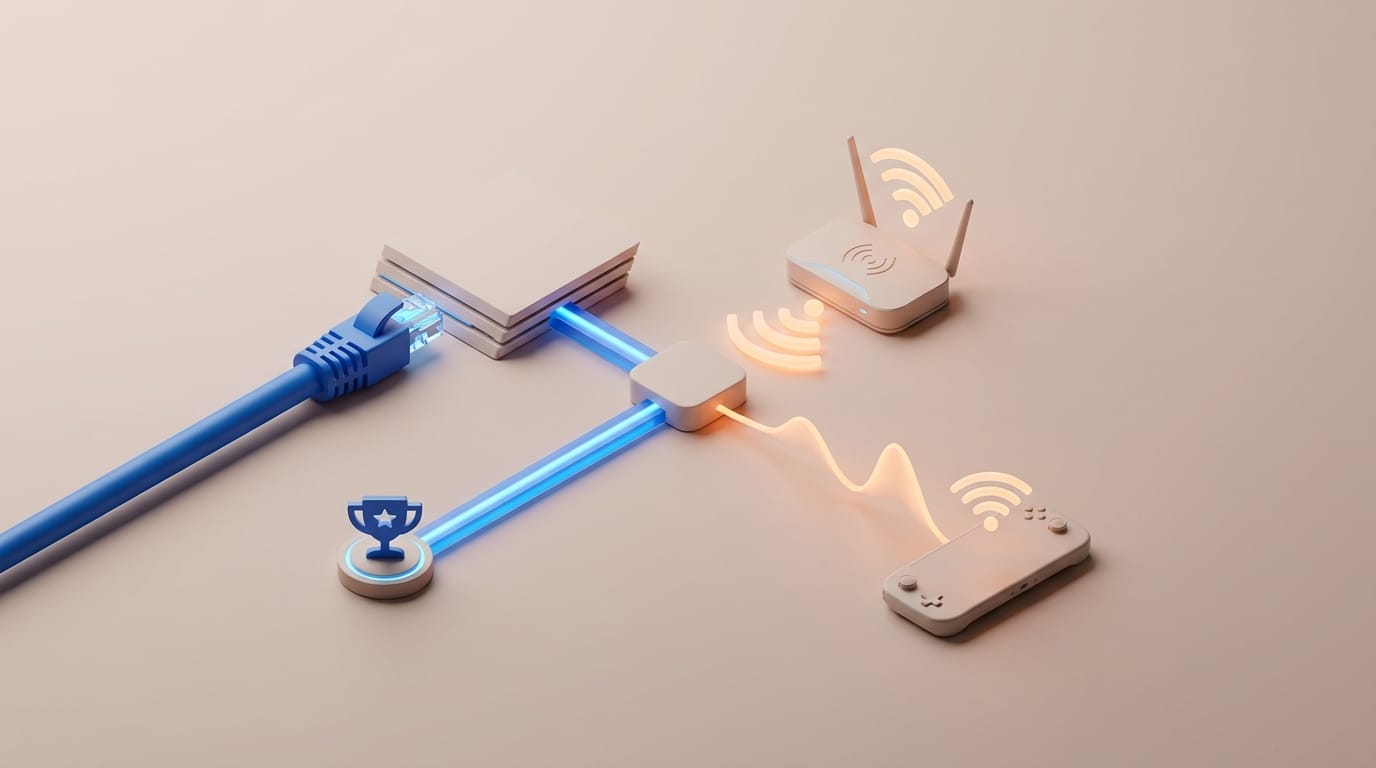
Most gamers upgrade their internet speed to fix lag, yet they often ignore the physical medium that causes most performance bottlenecks. When a match is decided in a single frame, the debate of ethernet vs wifi for gaming becomes less about convenience and more about the fundamental physics of data transmission. We have access to multi-gigabit fiber and ultra-fast wireless standards today, but the frustration of a lag spike remains a common experience. This usually happens not because the internet service provider fails, but because the local network cannot deliver packets with perfect regularity. While wireless technology has made massive leaps, a physical copper cable remains the gold standard for anyone serious about competitive play.
To understand why a wired connection still beats the most advanced routers, we have to look past marketing numbers. Providers often sell high-speed internet based on throughput, which is the total amount of data a connection can move at once. For gaming, throughput is secondary to the precision of timing and the elimination of tiny delays that the human eye perceives as stutter. Even the fastest wireless signal must fight through the air, while a cable provides a shielded, direct path for every command you send.
The Difference Between Bandwidth and Connection Quality
Why raw download speed matters less than you think
A persistent myth suggests that faster internet results in faster gaming. In reality, most modern titles like Valorant or League of Legends only require 3 to 6 Mbps of bandwidth to maintain a match. This is a tiny fraction of a standard 300 Mbps or 1 Gbps plan. Extra bandwidth helps when you are downloading the game or optimizing in-game graphics settings that require cloud-synced assets, but it does nothing to improve reaction time during a firefight. A massive pipe does not matter if the water moving through it arrives in irregular bursts.
The role of ping in online gaming responsiveness
Ping, or latency, measures the time it takes for a data packet to travel from your device to the game server and back. In modern competitive gaming, players consider an ideal ping to be under 20ms. While Wi-Fi can occasionally hit these numbers, it frequently adds 10 to 30ms of overhead compared to a wired link. This base delay is the tax you pay for the convenience of living without a cable. In fast-paced matches, this delay can cause the server to drop your inputs or miscalculate your position relative to an opponent.
Why Ethernet vs Wifi for Gaming Performance Starts with Jitter
How inconsistent packet delivery creates stutter
While high ping is annoying, jitter is the true enemy of competitive gaming. Jitter describes the variation in the time between packets arriving. If your first packet takes 20ms and the next takes 60ms, the game engine must guess where your character should be. This results in rubber-banding, where you appear to snap back to a previous position. Ethernet provides a dedicated physical path that virtually eliminates jitter, ensuring that the ethernet vs wifi for gaming comparison favors the cable for its stability.
The impact of network congestion on wireless signals
Wireless signals are half-duplex, meaning they generally cannot send and receive data at the same moment on the same frequency. They have to wait for a clear moment to talk. Ethernet is full-duplex; it uses separate physical lanes for sending and receiving, allowing for constant, uninterrupted communication. In a household with multiple phones, tablets, and smart TVs, those clear moments for Wi-Fi become rarer. This leads to the micro-interruptions that plague wireless gamers, even when they have a strong signal icon on their screen.
The Hidden Impact of Bufferbloat on In-Game Lag
Understanding packet queuing and network delays
Bufferbloat occurs when a router or modem gets overwhelmed with more data than it can immediately process. This forces the device to store packets in a buffer or queue. Think of it like a traffic jam at a toll booth. Your high-speed fiber connection might handle 1,000 cars per hour, but if the toll booth only processes one at a time, a backup forms. For a gamer, being at the back of that queue means a shoot command sits in memory while the router processes a roommate’s video stream first. This creates sudden, unpredictable spikes in latency that can ruin a match.
How routers handle data under heavy load
Wired connections bypass many of the complex signal processing tasks that routers must perform for Wi-Fi, such as error correction and airwave encryption. This reduced overhead allows the router to move packets faster. Even with modern on-device AI hardware designed to prioritize traffic, a physical cable remains the most efficient way to reduce the queuing delay. By removing the need for the router to manage wireless handshakes and interference checks, you ensure your gaming data stays at the front of the line.
Physical Barriers and Interference in Wireless Environments
The physics of radio waves vs copper wiring
Wi-Fi relies on radio frequencies that are easily disrupted by physical matter. Water in the pipes, metal studs in apartment walls, and even the density of the air can degrade the signal. Every time a packet is lost or corrupted by interference, the system must re-send it, which doubles or triples the latency for that specific action. Ethernet cables, specifically Category 6 (Cat6) or higher, use twisted-pair shielding to block external electromagnetic noise. This keeps the data pristine from point A to point B without the need for constant re-transmissions.
Common household devices that disrupt Wi-Fi signals
Interference does not just come from walls; it comes from other electronics. Microwaves, baby monitors, and even Bluetooth headsets operate on frequencies similar to 2.4GHz Wi-Fi. In high-density living areas, your neighbors’ routers also compete for the same airwaves. This creates a noisy environment where your signal has to shout over the crowd. A wired connection is effectively a private tunnel where no outside noise can enter, providing a level of reliability that wireless standards cannot physically match.
MoCA Adapters Provide Wired Stability Without Ethernet Cables
Using existing coaxial cable lines for networking
If you are a renter or live in a house where drilling holes for Ethernet is not an option, MoCA (Multimedia over Coax Alliance) is a powerful alternative. Most homes have coaxial cable outlets for TV in every room. MoCA adapters turn these existing wires into a high-speed network backbone. You simply plug one adapter into your router and another into the coax outlet in your gaming room. The result is a connection that offers reliable performance with significantly lower latency than Wi-Fi.
Performance benchmarks for MoCA vs traditional Wi-Fi
Benchmarks for MoCA 2.5 adapters show local latency as low as 3 to 5ms, compared to the 15 to 50ms common on Wi-Fi. While this is slightly higher than the sub-1ms latency of a direct Cat6 cable, it is vastly superior to any wireless solution. This makes it an ideal choice for users who want to explore Linux gaming or competitive esports without the instability of a wireless signal. It bridges the gap between the flexibility of Wi-Fi and the performance of a hardwire by using shielded cables already in your walls.
When Modern Wi-Fi 6E or 7 Becomes a Viable Alternative
The benefits of the 6GHz band for gaming
The newest wireless standards have introduced the 6GHz band. This is a massive improvement because it is currently less crowded than older bands. It allows for wider channels and faster speeds. For a casual gamer, these standards are more than enough to provide a smooth experience. However, the 6GHz band has a shorter range and is even more sensitive to physical barriers than 5GHz. This means you generally need to be in the same room as the router to see the benefits, which often defeats the purpose of choosing wireless over a short cable.
Comparing Wi-Fi 7 latency improvements to standard Ethernet
Wi-Fi 7 includes features like Multi-Link Operation, which allows a device to send data over multiple frequencies at once. This reduces the chance of a lag spike if one frequency gets blocked. Network analysis shows that while Wi-Fi 7 is remarkably fast, it still cannot guarantee the rock-solid consistency of a physical wire. Wireless remains a choice of convenience, whereas Ethernet remains the choice for pure performance. When you consider the ethernet vs wifi for gaming tradeoff, the cable always wins on reliability.
Your network is as important as your GPU whether you are building a professional streaming setup or climbing a ranked ladder. While you work on your digital hygiene by following essential cybersecurity tips, do not forget the physical layer of your home. A $15 Ethernet cable is often the single most effective hardware upgrade you can make to your gaming experience. It replaces the chaos of the air with the controlled environment of a copper wire, turning unpredictable variables into a constant. As games move toward more complex simulations, the tiny margins provided by a wired connection will only become more significant.