
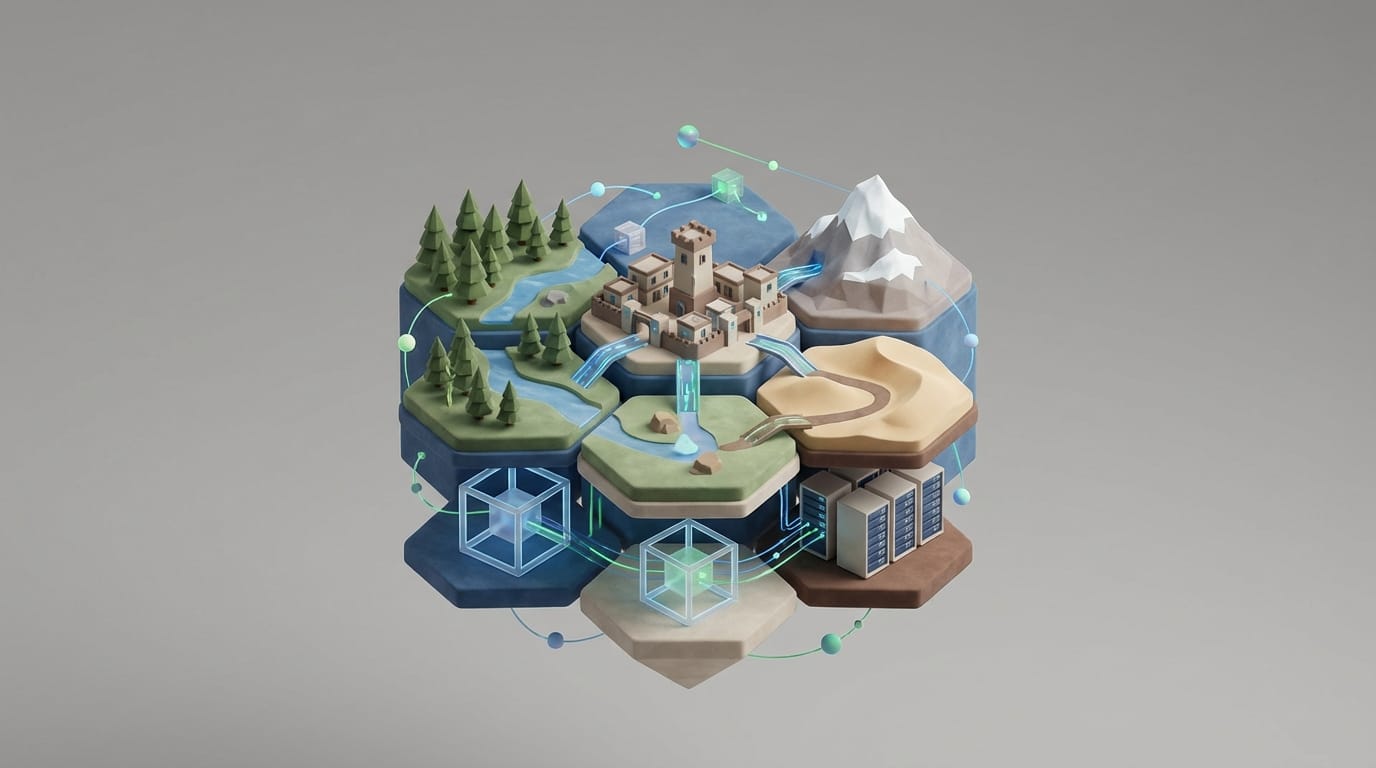
Defining the True Architecture of Open World Games
The true appeal of open world games lies not in the physical size of their maps but in how players control their own progress through the game’s internal logic. When we focus only on geography, we miss the technical elegance of non-linear design; a large map serves as a container, while a functional world acts as a reactive engine. To understand these systems, we must look past the visual horizon and examine how player agency functions. In a linear experience, the developer acts as a choreographer who directs every move, but in an open environment, the developer becomes an architect of systems. This shift requires a fundamental change in how we define progress and interaction within a digital space.
Moving Beyond the Concept of Map Size
In earlier eras of development, studios used map size as a primary way to market new titles. However, a massive environment with sparse interaction is little more than a large menu for selecting missions. The distinction between an empty map and a functional world lies in the density of its systems. A player might walk across a continent, but the world remains static if they cannot influence the plants, animals, or factions they meet along the way. True openness depends on how much the player can disrupt the intended flow of the game. When a designer creates a world, they build a physics and logic engine where different variables collide in ways the creator might not have planned. This density of variables makes a world feel expansive regardless of its literal mileage.
Why Systemic Agency Outweighs Simple Navigation
Players often confuse agency with movement, yet true agency is the power to make meaningful changes to the state of the game. Modern design prioritizes systemic agency, which allows players to use the world’s internal rules to solve problems. For example, if a player uses a fire spell to create an updraft and glide over a wall, they engage with the world as a system of logic rather than a series of simple triggers. Historically, games used invisible walls or hard-coded barriers to keep players on a specific path. In recent years, the industry has moved toward reactive boundaries. These systems do not tell the player no; instead, they ask how the player will proceed, which helps in developing game literacy by rewarding experimentation over memorization.
The Power of Non-Linear Order of Operations
Decoupling Progress from Fixed Sequences
The most profound shift in the design of open world games is the decoupling of story milestones from a fixed sequence. Traditional game design requires event A to lead directly to event B, but a non-linear framework grants the player control over the order of operations. This means the logic of the world must remain consistent whether the player tackles the final challenge first or spends hours engaging with side systems. This approach requires a robust state-management system where developers ensure that character dialogues, environmental states, and difficulty levels adjust based on player actions. It is a complex balancing act that prevents the player from breaking the story while still allowing them to stray from the intended path.
How Developers Facilitate Unplanned Player Solutions
When designers allow players to bypass intended routes, they invite emergent gameplay. This occurs when the tools provided to the player, such as physics, artificial intelligence, and elemental reactions, combine to create solutions the developers never tested. A player might use a heavy object to trigger a pressure plate from a distance or manipulate enemy behavior to fight a boss on their behalf. Facilitating these solutions requires a shift from scripted design to systemic design. Instead of coding one specific solution for a puzzle, designers code the properties of the objects within that puzzle. If an object is heavy, it triggers the plate; if it is flammable, it burns. By adhering to these universal rules, the game remains logical even when the player acts unpredictably.
Essential Components of Persistent Digital Landscapes
Environmental Storytelling Through Persistence
A persistent world remembers the impact of the player. If you clear a bandit camp or alter a landmark, the world should reflect that change hours later. This persistence validates player choice and transforms the map into a historical record of their journey. Environmental storytelling uses this permanence to tell stories without dialogue; a bloodstain on a trail or a newly settled village speaks volumes about the shifting state of the world. Persistence also extends to the evolution of game AI, where non-player characters change their routines or attitudes based on the player’s reputation. This creates a feedback loop where the player feels like a part of the world rather than a visitor passing through it.
Dynamic AI and Reactive Environments
In a truly open world, the AI must function independently of the player. Predators hunt prey and factions clash even if the player is miles away, which creates the illusion of a living world. When the player stumbles upon these interactions, they feel like they are witnessing a natural event rather than a scripted play. Simulating this level of activity requires significant processing power. To manage this, developers use radius-based simulation where the intensity of the logic increases as it gets closer to the player. This maintains the feeling of a reactive world without taxing the hardware with thousands of simultaneous calculations.
Technical Architecture of Expansive Environments
Managing Data Through Seamless World Streaming
Managing memory remains one of the hardest technical challenges for open world games. Since a map is often too large to fit into a computer’s memory all at once, developers use seamless world streaming. As the player moves, the game silently loads new data cells ahead of them while unloading the areas they have left behind. To make this transition invisible, engines like Unreal Engine or Unity use background processes to handle data movement. If the streaming system is too slow, the player sees objects suddenly appear or reaches a loading screen. Advanced techniques, such as level-of-detail transitions, allow the engine to render distant mountains as simple shapes while reserving high-quality details for the objects immediately in front of the player.
The Illusion of Continuous Exploration
To maintain the feeling of an unbroken world, designers use techniques like occlusion culling. This system ensures the computer only renders what is within the player’s field of vision. By not drawing the world behind the player’s head, the system saves resources that developers can use to make the visible world more detailed. This architecture supports the cross-platform play evolution we see today, as massive worlds can run on various hardware setups. By scaling the streaming speed and asset quality, developers provide a consistent experience across different tiers of hardware power.
Why Emergent Gameplay Drives Modern Engagement
Unscripted Encounters and Personal Narratives
Emergent gameplay provides the stories that players share with one another. These stories happen uniquely to one person because of a specific collision of systems. Perhaps a dragon attacked a giant while the player was sneaking past, or a thunderstorm short-circuited an enemy’s armor. These moments are not in the script; they are products of the world’s internal logic. These personal narratives are often more memorable than the main plot because they represent a direct result of the player’s presence in the world. When the systems are deep enough, the game becomes a story generator that provides endless replayability as players return to see how different choices yield different outcomes.
Balancing Infinite Freedom with Structured Motivation
The paradox of design is that too much freedom can lead to choice paralysis. Without a goal, a player may wander aimlessly and lose interest. Effective design uses soft guidance, such as a distant lighthouse or a rising plume of smoke, to pull the player toward content without forcing them. This requires balancing game design difficulty so that the player feels challenged regardless of their chosen path. If a player enters a high-level area early, the game must decide whether to punish their curiosity or reward their skill. Most modern systems use dynamic scaling to ensure the world remains dangerous but accessible, preserving player agency over the adventure. Ultimately, the goal of these complex systems is to fade into the background. When an open world works well, the player forgets the underlying data cells and simply feels as though they are in a place where their choices matter.