
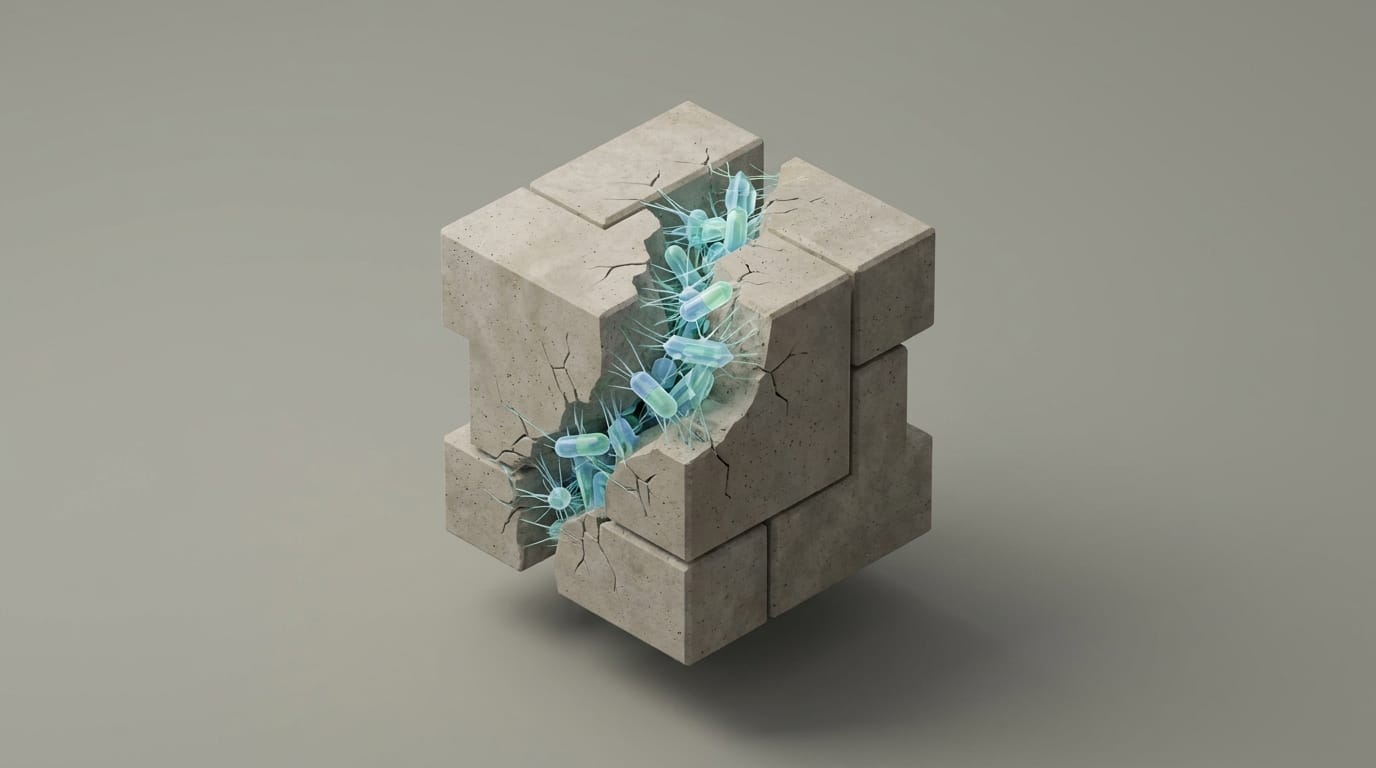
When microscopic fissures develop in concrete, the chemical integrity of the entire structure suffers. These tiny cracks lead to high maintenance costs that engineers could avoid by using materials that respond to damage on their own. Most infrastructure today relies on the rigid strength of the cement matrix, yet this very rigidity makes buildings and bridges prone to brittle fractures during earthquakes or temperature shifts. Effectively managing self-healing concrete chemistry allows engineers to move away from reactive repairs and toward a system where the material identifies and fixes its own structural voids.
The global impact of this shift is significant because the concrete repair market currently commands a multi-billion dollar valuation, according to industry projections from Research Nester. As cities grow, the cost of fixing older structures manually continues to rise. This pressure forces a move toward materials that exhibit autonomous behavior. By understanding the chemical pathways involved—from bacterial growth to molecular bonds—engineers can build structures that last much longer without human intervention. This technical progress reflects a broader trend where the principles of structure and function design work together. In these systems, the internal makeup of the material is a active reservoir of agents waiting for a trigger to start the repair process.
The Limitations of Natural Autogenous Healing
Concrete has a small, natural ability to fix itself known as autogenous healing. This process happens without any added chemicals and relies on the balance of the existing mix. When a micro-crack forms, it exposes unhydrated cement particles to moisture and air. This exposure triggers secondary reactions that can partially fill the gap. While this is helpful, it is rarely enough to fix significant structural damage on its own.
Carbonation and Hydration in Micro-crack Stabilization
The primary way concrete repairs itself naturally is through the continued hydration of cement minerals. In most standard mixes, much of the cement at the core of the particles never actually reacts with water during the initial pour. When water enters a crack later, it hits these dry cores and forms a new gel that fills the space. At the same time, calcium hydroxide in the concrete reacts with carbon dioxide from the air to create calcium carbonate crystals. These crystals act as a physical filler that narrows the crack and stops water from seeping through.
Thresholds for Effective Autonomous Repair
Natural healing worked well for ancient Roman concrete methods, but modern cement faces strict limits. Research shows that cracks wider than 0.3 millimeters usually cannot seal themselves through natural processes. This passive repair also requires constant moisture, which means it fails in dry climates or inside buildings. Because of these limits, engineers must create autonomous systems that work regardless of how much unreacted cement is left or how dry the air is.
The Bio-Chemical Pathway of Calcite-Producing Bacteria
One popular autonomous system puts living bacteria into the concrete mix. This bio-concrete uses specific bacteria strains that can survive in the harsh, high-alkaline environment of wet cement. Engineers add these bacteria to the mix as dormant spores, usually tucked inside tiny protective shells along with a food source like calcium lactate. These spores stay quiet for years until a crack appears and wakes them up.
Microbial Metabolism and Calcium Carbonate Precipitation
The chemical trigger for bio-concrete is the actual breaking of the concrete. As a crack spreads, it pops the bacterial capsules, which lets in water and oxygen. The bacteria wake up and begin to eat the calcium lactate. This process turns the organic food source into solid limestone through a chemical reaction. The resulting mineral growth fills the crack from the inside out, creating a bond that matches the strength of the original material.
Ureolytic versus Denitrifying Metabolic Pathways
Engineers generally choose between two ways for bacteria to create limestone. One group of bacteria uses an enzyme to break down urea into carbonate. While this works fast, it releases ammonia, which can lower air quality inside buildings. Another group uses nitrates to produce the same limestone filler along with nitrogen gas. Both methods create a permanent bond that is chemically the same as the limestone used to make the cement in the first place.
Micro-encapsulated Self-Healing Concrete Chemistry
Other systems rely on man-made capsules filled with glue-like resins rather than living bacteria. These agents use standard chemical reactions to seal gaps. The capsules stay stable while the concrete is mixed and poured, but they are designed to break the moment a crack hits them. The effectiveness of encapsulated self-healing concrete chemistry depends on the strength of the capsule wall. If the wall is too strong, the crack might just move around it; if it is too weak, the capsules will break before the concrete even sets.
Rupture Mechanics and Core-Shell Integrity
When a capsule breaks, the liquid inside—usually a type of epoxy or silicate—flows into the crack. Capillary action pulls the liquid into the tightest spaces of the fracture. Once the liquid fills the void, it reacts with the surrounding concrete to harden. This rapid reaction stops the crack from growing and prevents water or salt from reaching the steel bars that hold up the building.
Polyurethane versus Epoxy Resin Reactivity
The choice of healing agent changes how fast and how strong the repair becomes. Some capsules use sodium silicate because it reacts directly with the minerals already in the concrete. This creates more of the binder that gives concrete its strength. Studies from the University of Rhode Island show that these systems can make a structure water-tight again almost immediately after the capsules break. This speed is vital for structures like dams or tunnels where water leaks cause fast damage.
Molecular Velcro and Reversible Bonding
While capsules and bacteria usually provide a one-time fix, some new materials use “Molecular Velcro.” This system uses special polymers that allow for many repair cycles in the same spot. Traditional chemical bonds break and stay broken, but these polymers use a different type of attraction. This allows the surfaces to re-attach whenever they touch, much like the hooks and loops on a piece of fabric.
Supramolecular Polymers in Cementitious Matrices
Engineers create this Velcro effect by adding small amounts of engineered polymers to the cement. These polymers form a flexible network inside the concrete. When a crack starts, the polymer chains actually move toward the break. Because the bonds are dynamic, the polymer acts like a microscopic fastener that pulls the sides of the crack together. This helps the concrete maintain its shape even under heavy weight or repeated stress.
Overcoming Single-Use Limitations
This reversible bond fixes the biggest problem with capsules. In a capsule system, once the liquid is used up, that spot cannot heal again. Pacific Northwest National Laboratory research shows that Velcro technology helps cement regain its strength even after many cycles of stress. This makes it ideal for areas with frequent earthquakes or heavy truck traffic where cracks might open and close many times.
Comparing Chemical and Biological Healing Efficiency
Choosing the right system requires balancing how fast the repair happens against how long the bond lasts. For busy bridges, the quick hardening of chemical resins is often the best choice. For deep foundations or tunnels, the long-term stability of bacterial limestone might be better. Each method has specific strengths that engineers must weigh before construction begins.
- Speed: Chemical resins cure within hours, offering a fast return to full strength. Bacterial growth is slower and often takes days or weeks to fill a crack.
- Durability: Bacterial limestone is very hardy and resists sun damage and chemicals, lasting as long as the concrete itself. Some resins can break down over several decades.
- Repeatability: Polymer systems are currently the only way to fix the same crack more than once.
Researchers are now testing hybrid systems that combine the flexibility of polymers with the strength of minerals. This mix helps cities handle more extreme weather and higher use. Using these tools ensures that the foundation of a city stays strong without the need for constant, expensive work crews.
Future Applications in Sustainable Urban Infrastructure
The move toward self-repairing concrete is also about saving money. While these materials cost more at first, they save money over time by making repairs less frequent. In the coming decades, the world will need trillions of dollars in new infrastructure. This level of building is not possible if we continue to use materials that require constant fixing. Using better chemistry helps bridge the gap between building needs and available budgets.
Reducing the Carbon Footprint of Cement
Concrete production generates about 8% of the world’s carbon emissions. Much of this comes from replacing old, crumbling structures. If we can make a bridge last 50 years longer, we do not need to make as much new cement. This longevity is a major part of making the construction industry more eco-friendly. By extending the life of what we already have, we protect the environment and save resources.
The final step is connecting these materials to smart city technology. Future buildings might have sensors that track how well the concrete is healing in real-time. This allows city planners to see the health of a bridge as easily as they see a traffic map. Combining chemical engineering with data creates a smarter built environment. Using the principles of self-healing concrete chemistry, we can build cities that adapt to stress instead of just breaking under it. This shift ensures that our buildings and roads last for the next century and beyond.
The ability of a material to fix itself might change how we think about maintenance. Instead of sending crews to a job site, the real work happens in the laboratory before the first stone is laid. As we build in more extreme places, these systems will decide if our cities remain permanent or if they slowly crumble away.