
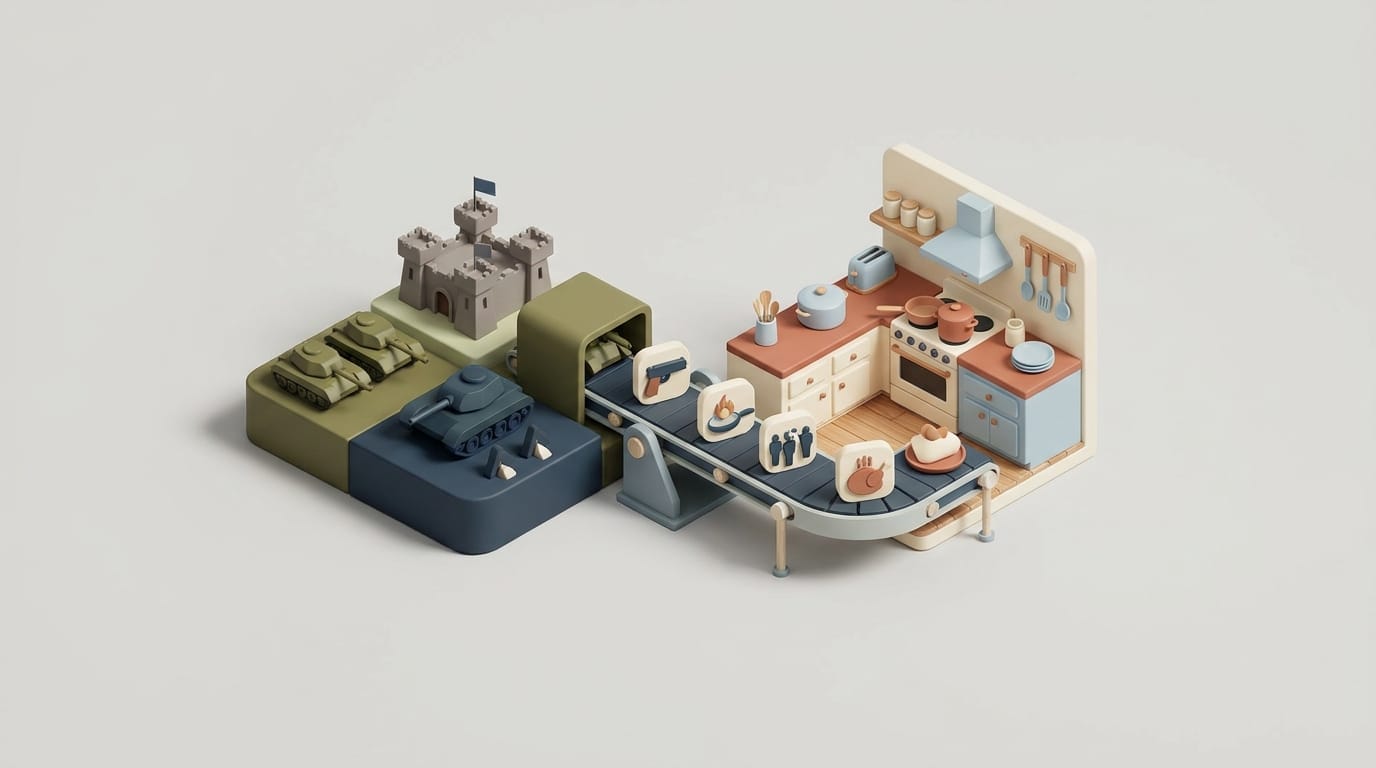
Language follows history like a shadow, though few realize that the high-stakes logistical machines of the 18th-century battlefield forged the common metaphors used in kitchens and offices today. These military idiom origins reflect a time when the industrialization of war required precise communication to ensure thousands of men could be fed, clothed, and moved in unison. When we speak of being “in the trenches” or getting a “square meal,” we are accessing a linguistic system developed by military organizations to manage chaos.
The survival of combat vocabulary in civilian life is no accident. The military builds systems for high-stress environments where ambiguity leads to failure, which makes their terminology naturally memorable. Over centuries, as mass mobilization brought millions of civilians into contact with these rigid structures, the physical trauma of the battlefield shifted into social metaphors. We no longer use these phrases to describe literal combat, but we retain them because they provide a structural clarity that civilian language often lacks.
This linguistic transfer moved quickly through massive logistical machines, including mess halls, supply chains, and uniform production lines. These systems brought military precision into daily civilian habits. It was not just the front-line soldier who shaped our tongue, but the quartermaster and the cook. By examining the systems behind these phrases, we can see how the architecture of war became the blueprint for modern conversation.
The Mess Hall and the Invention of Kitchen Standards
In the civilian world, a meal is a social event; in the military, it is a logistical requirement. This shift in perspective is responsible for many common dining idioms. While popular legend suggests the “square meal” comes from square wooden plates used by the Royal Navy, etymologists often classify this as a folk etymology; in reality, “square” served as a metaphor for something solid and substantial. Much like the standardization of time helped coordinate global movements, the “square” meal represented a reliable unit of energy for a soldier.
The urgency of the parade ground also dictated the pace of the kitchen. When a supervisor tells an employee to do something “on the double,” they are referencing a specific military cadence. “Double time” was a marching speed of 180 steps per minute, twice the standard rate. As noted in an analysis of common military phrases, this obsession with speed carried directly from marching formations into everyday life, where it remains a shorthand for immediate action.
Even the term “scuttlebutt,” now used for office gossip, originated at the ship’s water barrel. A “scuttle” was a hole cut into a “butt” (a large cask) of drinking water. Because sailors gathered there to drink, it became the natural hub for sharing news and rumors. This system of informal information exchange around a central resource is the direct ancestor of modern water cooler talk.
Field Medicine and the Vocabulary of Endurance
The 19th-century battlefield was a laboratory for endurance, and the phrases born there reflect the grim reality of medicine before modern drugs. To “bite the bullet” is perhaps the most visceral example. Before surgeons used anesthesia, they often gave wounded soldiers a soft lead bullet to clench between their teeth to keep them from screaming or biting their tongues during surgery. This physical act of enduring agony has evolved into a metaphor for facing any unpleasant but necessary task.
World War I introduced a different kind of endurance through the static, grinding misery of the Western Front. To be “in the trenches” once meant literal immersion in mud, disease, and constant shelling. Today, people use it to describe the long-term perseverance required in a high-pressure workplace. This transition from physical trauma to social struggle shows how military idiom origins adapt to peace-time needs. The psychological weight of that era changed how we describe struggle, moving us away from temporary battles toward the idea of trench warfare as a permanent state of competition.
This era also gave us “over the top,” which originally described the act of climbing out of a trench to attack the enemy. It was a moment of extreme bravery. In a modern context, however, the phrase has softened to mean something excessive. We see a similar shift in post-war design movements, where the harshness of the war years was replaced by the geometric optimism of Art Deco, yet the underlying structures of the era remained.
The Massive Logistics Machine of Military Idiom Origins
Many of our most polished phrases stem from an 18th-century obsession with uniformity and visibility. To “pass with flying colors” is a maritime term. When a victorious ship returned to port, it would fly its flags (its “colors”) high to signal success. If a ship suffered defeat, it would often “strike its colors,” or lower its flags, as a sign of surrender. The system of fleet identification was so critical to naval operations that it naturally became a metaphor for succeeding in an inspection or a test.
Logistical standards also gave us the phrase “spick and span.” While the roots of the words are older (spick referring to a nail and span to a fresh wood chip), the military popularized its use to describe the required state of equipment. In an era where structure and function design dictated that every piece of kit be in its exact place, “spick and span” became the shorthand for a system that was perfectly maintained. This was not about how things looked; it was about ensuring that every component of the military machine was ready for use.
The mass production of uniforms meant that for the first time, thousands of men wore identical clothing. This required a level of quality control unknown in civilian life. Phrases like “to a T” or “squared away” emerged from this environment of exacting standards. When a soldier’s kit was “squared away,” it met the geometric and functional requirements of the quartermaster’s manual, a concept that persists in our desire for organized lives.
Chain of Command and the Rules of Communication
As technology advanced, the language of the machine began to merge with the language of the soldier. The phrase “balls to the wall” is often misunderstood, but it is actually a piece of mechanical history. Early aircraft and steam engines used centrifugal governors to regulate speed. As the engine spun faster, the weights (the balls) would swing outward. Pushing the throttle levers (which also had ball-shaped grips) all the way to the cockpit wall meant the engine was at its maximum limit. According to historical records of mechanical governors, this system ensured the machine operated at peak capacity without breaking.
The hierarchy of the military also provided a template for corporate discipline. Giving someone their “marching orders” transitioned from a literal directive to a subordinate to a common way of describing a dismissal or a final set of instructions in business. This transfer of discipline was essential for the expansion of large-scale industry, which owners often modeled on military command structures.
Other communication protocols, like “Roger that,” were born from the necessity of clarity over poor radio links. During World War II, the letter ‘R’ stood for “received.” To ensure there was no confusion, the phonetic alphabet used “Roger” for the letter R. Even “over and out” serves a technical purpose: “over” means the speaker is waiting for a reply, while “out” means the conversation is ending. Using both together is technically a contradiction, but civilian use favors the feeling of finality over the logic of the protocol.
The Precision of a Mobilized Society
Many people prefer the clarity of military metaphors because they provide comfort in a complex world. In a civilian environment where goals are often vague, the binary nature of military idiom origins (victory or defeat, on-speed or overspeed) offers a sense of progress. This is why we speak of “targets,” “objectives,” and “mission-critical” tasks even when the stakes are purely financial or administrative.
The future of language will likely continue this trend through the lens of digital and cyber conflict. We already see phrases like “going dark,” “firewalling,” and “bad actors” move from intelligence and defense into our daily vocabulary. Just as the strategic invention of the weekend responded to the pressures of the Industrial Revolution, our language continues to adapt to the systems we inhabit.
Ultimately, these idioms are more than historical trivia. They are the linguistic record of how we have organized ourselves to face high-stakes challenges. By understanding the mechanical and logistical origins of these phrases, we gain a clearer view of the rigid systems that shape how we think and speak. The military did not just give us tools to fight; it gave us the tools to describe the world we built once the fighting was over.
The true legacy of these idioms lies in their transition from the battlefield to the boardroom and the breakfast table. They remind us that the systems we live inside are rarely built from scratch. Instead, we repurpose them from high-pressure environments to provide structure to our present. Whether it is the mechanical limit of a governor or the rigor of a mess hall plate, these phrases ground our abstract ideas in physical reality. As our society becomes more automated, we continue to rely on the metaphors of the infantry to navigate the world. The next time you finish a “mission” at the office, you are still speaking the language of a mobilized world.