If we continue to view the vacuum as an empty void, we ignore the active quantum vacuum that dictates the limits of light and matter. This invisible medium is not just a stage where physics happens; it is the lead actor in the play. Understanding how to control it shifts our view of “nothing” into a physical material we can stress, polarize, and eventually transform into solid matter.
For decades, the idea that empty space was truly empty served as a useful estimation for engineering. However, as our laser technology approaches the petawatt and exawatt scales, that estimation no longer works. We find that the vacuum has a texture, a resistance, and a memory, functioning more like a complex fluid than a static container. To a senior engineer, the vacuum increasingly looks like a system that we can hack. By applying extreme electromagnetic pressure, we can force the void to reveal its internal machinery, turning the most fundamental layer of reality into a controlled laboratory for the future of physics.
The Hidden Activity Within Empty Space
Classical physics defines a vacuum by the absence of everything. If you pump every atom out of a chamber, you expect to find zero energy and zero activity. Quantum field theory tells a much more restless story. It suggests that even at absolute zero, space is a boiling sea of activity governed by the Heisenberg uncertainty principle. This principle prevents any field from having a precisely defined value of zero for any amount of time. Instead, the energy in a quantum vacuum fluctuates constantly, allowing pairs of virtual particles and antiparticles to pop into existence.
These pairs, usually an electron and its antimatter twin, the positron, exist on borrowed energy and destroy each other almost as quickly as they appear. They are virtual because they do not last long enough for us to observe them under normal conditions, but their presence influences the energy levels of atoms. Think of it as a background noise floor in a high-precision circuit. Just as you cannot have a perfectly silent electrical signal because of thermal noise, you cannot have a perfectly empty space because of quantum changes. This dynamic field is the foundation of the universe, and it behaves much like the systems scientists study when balancing Earth’s energy budget, where every change must eventually reach equilibrium.
Why the Quantum Vacuum Acts Like a Nonlinear Material
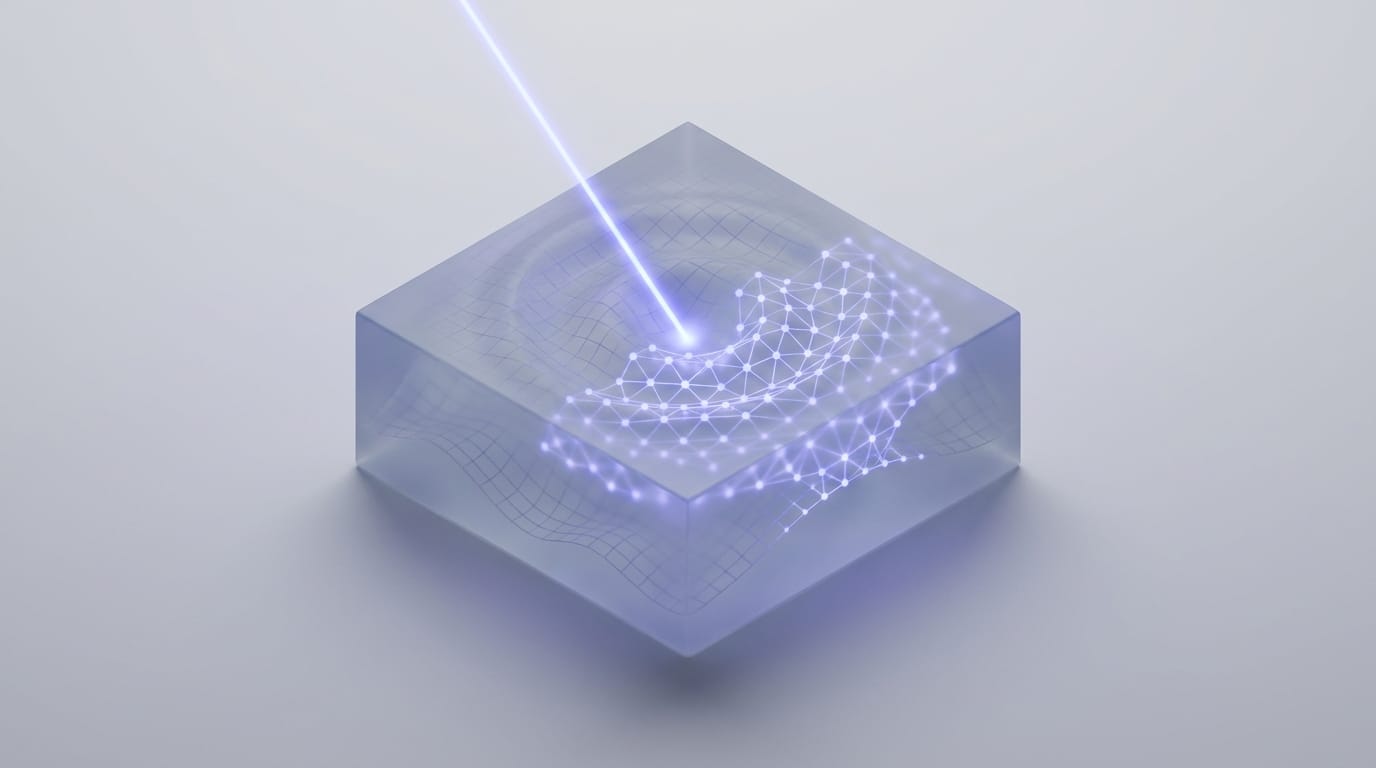
One of the most profound shifts in modern physics involves treating the quantum vacuum as a nonlinear material. In standard optics, if you shine two flashlights at each other, the beams pass through without interacting. This happens because the vacuum is linear at low energies. However, if the light is intense enough, it can polarize the virtual particles that inhabit empty space. When a powerful laser pulse hits a vacuum, the intense electric field pulls the virtual electrons in one direction and the virtual positrons in the other.
For a fleeting moment, the void behaves like a physical crystal. It develops a refractive index, meaning it can bend light, shift phases, and even cause different polarizations of light to travel at different speeds. Scientists call this vacuum polarization, and it effectively turns “nothing” into a quantum medium that reacts to external stress. This insight is critical because the vacuum is not a passive spectator. It is a nonlinear medium that we can saturate and control. Just as researchers use cryogenic quantum sensors to detect the faint whispers of dark matter, we use high-intensity lasers to put the vacuum under enough pressure that it starts to show the properties of a solid material. Researchers have recently begun simulating the vacuum in three dimensions to understand how these nonlinearities will affect the next generation of particle accelerators.
Refractive Indices and the Polarization of the Void
In a stressed vacuum, the speed of light is no longer a fixed constant in the way we usually imagine. Under the influence of a strong magnetic or electric field, the vacuum becomes birefringent. This means it splits a beam of light into two paths, each feeling a different refractive index. It is the same effect you see when looking through a piece of calcite, but here, the crystal is the fabric of space-time itself. As we push toward higher intensities, we are moving from passive observation to active editing. We are no longer just watching how light moves through space; we are changing the properties of the space light moves through. This is the hallmark of a true laboratory system where we change the parameters of the environment to see how the vacuum responds.
How High Intensity Lasers Probe the Invisible
To see these effects, we need lasers of unimaginable power. Facilities like the Extreme Light Infrastructure in Europe have already achieved the ten petawatt milestone, delivering pulses that concentrate more power than the entire world’s electrical grid into a space smaller than a human hair. These pulses are so short, lasting only femtoseconds, that they do not melt the lab, but they give the quantum vacuum a massive kick. One of the primary tools for probing this invisible structure is photon-photon scattering.
Classically, photons do not bounce off each other. But in a high-intensity laser field, two photons can interact by exchanging virtual particles from the vacuum. This process, often called vacuum four-wave mixing, allows scientists to bounce light off of light. Modern experiments involving vortex lasers attempt to detect these rare events with high precision. The mechanics of this are similar to nuclear fusion engineering. In both cases, we try to control extreme energy densities to force a phase change in the medium. In fusion, we turn gas into plasma; in vacuum physics, we turn the virtual sea into a polarized state that can deflect an incoming X-ray probe beam.
Reaching the Schwinger Limit to Create Matter
Physics predicts a breaking point for the vacuum known as the Schwinger Limit. Named after Julian Schwinger, this is the field intensity where the electric field becomes so strong that it provides enough energy to the virtual particles to turn them into real particles. At this point, the vacuum breaks, and the laser creates matter directly out of pure light. Scientists often describe this as “boiling the vacuum.” When we reach this threshold, the electron-positron pairs no longer destroy each other. Instead, the laser field rips them apart, and they become permanent additions to our universe.
This is the ultimate demonstration of E=mc², showing that energy and mass are two sides of the same coin. It proves that “nothing” is simply “something” waiting for enough energy to manifest. Experimentalists are currently in a race to reach this limit. While we have not arrived there yet, the focused intensity of multi-petawatt lasers gets closer every year. By using plasma mirrors to further compress laser pulses, researchers hope to trigger localized sparks of matter creation, effectively harvesting the vacuum for particles.
Turning the Vacuum into a Laboratory for New Physics
Treating the quantum vacuum as a lab allows us to test the limits of Quantum Electrodynamics, which is our most successful theory of how light and matter interact. If our experiments find even a tiny deviation from what the theory predicts, it could point toward new physics, such as hidden particles, extra dimensions, or clues about the nature of dark energy. The vacuum may also hold the key to new forms of particle acceleration. If we can engineer the vacuum to have specific refractive properties, we could potentially accelerate particles over much shorter distances than the miles-long tunnels of the Large Hadron Collider.
We are shifting from being observers of a fixed reality to being engineers of the medium that defines reality itself. The realization that the vacuum is a controllable medium changes our technological horizon. If we can polarize the void, we can build faster computers, more sensitive sensors, and perhaps one day, propulsion systems that interact directly with the quantum changes of space. The “nothing” we once ignored is becoming the most important tool in the engineer’s kit. As we push deeper into this modern era, the boundary between the empty stage and the physical actors continues to blur. The vacuum is a nonlinear material that we are learning to stress, bend, and break. This transition from viewing space as a void to viewing it as a complex, engineered system is the most significant shift in our physical understanding since the dawn of the atomic age. What happens when we finally reach the limit and begin to boil the nothingness will redefine our place in the universe.