
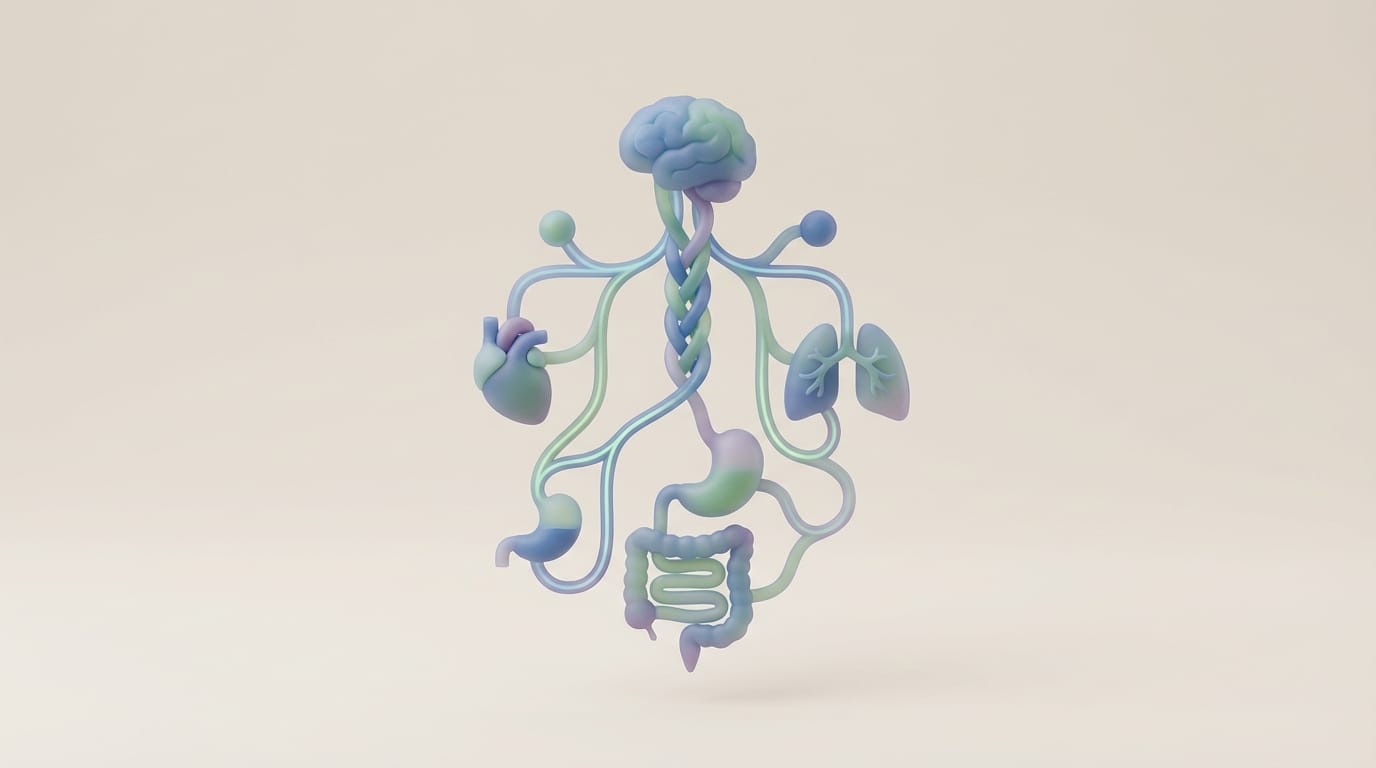
While most people view the brain as the body’s master controller, internal organs send four times more information upward through the vagus nerve than they receive from the mind. Understanding vagus nerve anatomy is the first step toward decoding how the brain and body communicate in a constant loop, rather than a top-down command structure. This massive nerve acts as the primary data cable for the parasympathetic nervous system, maintaining the background processes that keep you alive.
Experts call the vagus nerve, or cranial nerve X, the “wandering nerve” because of its extensive path from the brainstem to the lowest reaches of the abdomen. It is the longest and most complex of the twelve cranial nerves, serving as a biological superhighway that links thoughts and emotions to physical states. When people discuss the mind-body connection, they are usually describing the real-time activity occurring within this specific neural architecture.
Because the vagus nerve touches many systems, its health determines how effectively you recover from stress, digest nutrients, and manage inflammation. Misunderstanding the sheer scale of vagus nerve anatomy often leads to treating symptoms like heart palpitations or digestive distress in isolation, when the root cause often lies in the signaling efficiency of this central communication line.
Mapping the Longest Pathway in the Human Body
Tracing the path of the vagus nerve is like mapping the main fiber-optic trunk of a city’s network. It does not simply start and end, but branches and integrates into nearly every major organ system, allowing the autonomic nervous system to exert granular control over physiology without conscious effort.
Origins in the Brainstem and Cranial Exit
The journey begins in the medulla oblongata, which is the lowest part of the brainstem responsible for involuntary functions, as the nerve emerges from several nuclei like the nucleus ambiguus and the dorsal motor nucleus. From this origin point, the nerve fibers bundle together and exit the skull through the jugular foramen, which is a small opening shared with the glossopharyngeal and accessory nerves. This exit point creates a bottleneck where physical tension in the neck or upper spine can occasionally impact nerve signaling.
Branching Through the Thorax and Abdominal Cavity
Once it clears the skull, the vagus nerve descends through the neck within the carotid sheath while running alongside major blood vessels. As it enters the chest, it begins to branch aggressively by sending fibers to the larynx to control speech and the pharynx to manage swallowing. Further down, it forms the pulmonary and esophageal plexuses, wrapping around the lungs and the food pipe to coordinate vital functions. Finally, it passes through the diaphragm to reach the stomach, liver, and intestines, eventually ending near the splenic flexure of the colon. This wide distribution explains why a single nerve can influence everything from heart rate to the microbiome.
Understanding Vagus Nerve Anatomy as a Two-Way Street
A common misconception about the vagus nerve is that it is purely a motor nerve used by the brain to tell the heart to slow down or the stomach to digest. In reality, the vagus nerve anatomy reveals a bidirectional superhighway where the majority of traffic moves toward the brain, not away from it.
The Dominance of Sensory Fibers
Roughly 80 percent of the fibers within the vagus nerve are afferent, meaning they are sensory fibers that carry information from the body to the brain. These fibers provide constant feedback by reporting on the status of the heart, lungs, and gut, according to research from the Polyvagal Institute regarding how the vagus nerve tracks internal safety. Only about 20 percent of the fibers are motor fibers used by the brain to send commands back down. This ratio suggests that the brain is more of a listener than a dictator when it comes to internal regulation.
How Internal Organs Dictate Brain States
Because the brain receives such a high volume of data from the organs, your physical state often determines your mental state. If the vagus nerve reports that the gut is inflamed or the heart rate is erratic, the brain interprets these signals as danger or stress, even if no external threat exists. This explains why certain foods or breathing patterns can change your mood. By understanding this bottom-up signaling, you can see how choosing between matcha and coffee for energy changes focus by shifting the central nervous system from anxiety to calm.
Regulating Internal Stability Through the Parasympathetic System
The vagus nerve is the lead actor in the parasympathetic nervous system, which is the branch responsible for rest and digest functions. It serves as a counterweight to the sympathetic nervous system’s fight or flight response, acting as a natural brake that prevents the body from staying in a state of high alert for too long.
Modulating Heart Rate and Cardiac Rhythm
One of the nerve’s most vital roles is the regulation of the sinoatrial node, which is the heart’s natural pacemaker. By releasing a neurotransmitter called acetylcholine, the vagus nerve slows the firing of this node and lowers the heart rate. This vagal brake allows you to transition from a sprint back to a resting state. Without this anatomical check, the sympathetic system would keep the heart racing, leading to exhaustion and cardiovascular strain. This process often starts through reflexes, such as how the yawning reflex protects your brain by interacting with autonomic pathways to assist in neural cooling.
Controlling Respiratory Pace and Depth
While the phrenic nerve controls the diaphragm, the vagus nerve manages the smooth muscle in the airways. It monitors the stretch of the lungs during inhalation and signals the brain to end the breath, preventing over-inflation. This feedback loop is essential for maintaining a steady respiratory rhythm. When you practice deep, slow breathing, you essentially influence the vagus nerve anatomy by sending artificial signals of safety back to the brainstem, which in turn forces the rest of the body to relax.
Connecting the Brain and the Digestive System
The gut-brain axis is a physical reality facilitated by the vagus nerve. This connection allows the brain to coordinate the complex tasks of breaking down food and absorbing nutrients while managing the immune environment of the gastrointestinal tract.
Stimulating Gastric Acid and Digestive Enzyme Production
When you see, smell, or think about food, the vagus nerve initiates the cephalic phase of digestion. It signals the stomach to begin secreting gastric acid and the pancreas to release digestive enzymes before the first bite reaches your mouth. This preparatory work ensures that the digestive system is ready to process incoming fuel efficiently. If vagal signaling is weak, digestion can become sluggish, leading to issues like bloating or poor nutrient absorption.
Coordinating Peristalsis and Nutrient Absorption
The vagus nerve also controls peristalsis, which refers to the wave-like muscle contractions that move food through the digestive tract. It communicates directly with the enteric nervous system, a web of neurons often called the second brain. By coordinating these movements, the vagus nerve ensures that food stays in the stomach and small intestine for the correct amount of time to maximize nutrient extraction. This is why balancing active recovery and complete rest is important, as the body needs periods of parasympathetic dominance to focus energy on these internal processes.
The Vagus Nerve Role in Immune and Inflammatory Responses
In recent decades, scientists discovered that the vagus nerve does more than move muscles; it acts as an interface for the immune system. This discovery has led to the field of bioelectronic medicine, which uses nerve stimulation to treat chronic conditions.
Activating the Anti-Inflammatory Pathway
The vagus nerve can sense inflammation in the body. When sensory fibers detect pro-inflammatory markers, the brain sends a signal back down through the motor fibers to stop their production. Scientists call this the cholinergic anti-inflammatory pathway. By releasing acetylcholine near immune cells, the nerve prevents them from over-producing the chemicals that cause swelling and tissue damage. This mechanism is a vital internal regulator that prevents local inflammation from becoming a systemic problem.
How Vagal Tone Prevents Chronic Systemic Inflammation
Low vagal tone is associated with an inability to turn off the immune response, which can lead to chronic inflammation and autoimmune diseases. A study published by the National Institutes of Health suggests that maintaining a healthy vagus nerve can help regulate the stress response system and keep cortisol levels in check. This neuro-immune feedback loop demonstrates that vagus nerve anatomy is a primary pillar of long-term resilience against chronic disease.
Measuring Nervous System Health Through Heart Rate Variability
Because we cannot easily see the vagus nerve, we rely on physiological markers to measure its health. The most accurate and accessible marker available currently is Heart Rate Variability (HRV).
What HRV Reveals About Vagal Tone
Heart Rate Variability is the measure of the time difference between each heartbeat. Contrary to popular belief, a healthy heart does not beat like a perfectly steady metronome, but instead shows subtle variations. High HRV indicates that the vagus nerve is successfully modulating the heart rate in response to the breath and environment. Low HRV suggests that the sympathetic nervous system is dominating, leaving the heart in a rigid, stressed rhythm. Tracking this data is as essential to optimizing post-workout recovery as monitoring sleep or hydration.
Biological Markers of a Resilient Nervous System
A resilient nervous system is one that can spike into action when needed and return to a baseline of calm quickly. High vagal tone is the biological signature of this resilience, meaning your vagus nerve anatomy is structurally and functionally capable of dampening the stress response. Beyond HRV, other markers of healthy vagal tone include a strong diving reflex and the efficient recovery of heart rate within the first minute after intense exercise. These metrics provide a clear window into how well your internal superhighway is performing.
The complexity of the vagus nerve reminds us that physical well-being is not just about the health of individual organs, but the integrity of the signals passing between them. When we treat the body as a series of disconnected parts, we miss the system that unifies them. The vagus nerve is the literal cord that binds our physiological state to our psychological experience. As chronic stress and inflammatory diseases remain primary health challenges, understanding and supporting this neural architecture becomes a fundamental skill for survival. If you want to change how you feel, you must first change the data your body is sending to your brain. Enhancing your vagus nerve health ensures that this internal conversation remains harmonious and supportive of long-term health.