
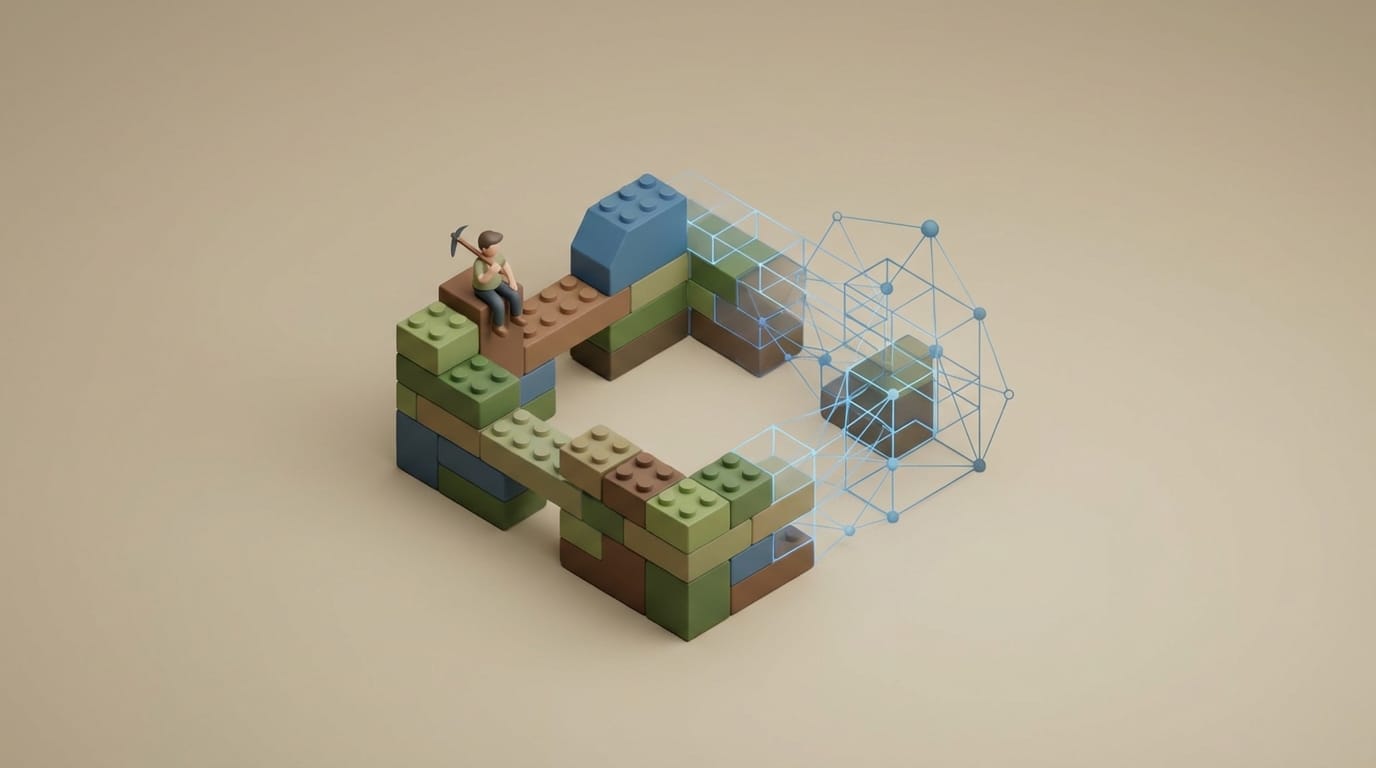
Traditional game design often focuses on removing friction and guiding every step the player takes, but Minecraft chose to hide its mechanics. This decision created a global communal research project that changed how we perceive play. By analyzing minecraft sandbox game design, we see how a lack of explicit instruction transformed a simple block-building tool into a complex social system. This philosophy prioritizes player agency over scripted stories, allowing the game to function as a platform rather than just a product.
Today, Minecraft remains a dominant force in the industry with over 204 million monthly active players. This sustained relevance results from a systemic architecture that encourages emergent gameplay. When a system provides tools instead of tasks, the player’s role shifts from a consumer of content to an architect of their own experience. This success forced the industry to rethink how software engages users. Instead of viewing a knowledge gap as a flaw to be patched with tutorials, designers now recognize it as a catalyst for community building. In this environment, the act of playing is inseparable from the act of discovery, turning every session into a collaborative experiment.
Analyzing the Core Minecraft Sandbox Game Design Mechanics
At its heart, a sandbox is a system without a set win state. While traditional games provide a linear path from start to finish, the minecraft sandbox game design relies on a loop of gathering resources and changing the environment. This structure shifts the focus from a scripted story to a set of interlocking systems, including gravity, light levels, entity behavior, and resource scarcity, that react to player input in predictable ways.
Prioritizing Systems over Scripted Narrative
In a systemic game, the developers do not write stories; they write rules. When a player encounters a creeper near their wooden house, the resulting explosion is not a scripted cutscene. Instead, it is an interaction between the AI of the mob, the proximity of the player, and the blast resistance of the wood blocks. This distinction helps us understand how open world games redefine nonlinear player agency. By ensuring that every element of the world follows the same logic, the game creates a reliable physics engine for the player’s imagination.
The Role of Emergent Gameplay in Player Retention
Emergent gameplay occurs when players use simple tools to create complex situations the developers never planned. Because Minecraft provides a true sandbox where every block can be moved, the possibilities for new situations are infinite. This generates replayability because the game does not run out of content. The content is simply the curiosity of the person playing. When players set their own goals, such as building a city or a massive farm, the motivation comes from within rather than from an arbitrary points system.
Why Voxel Architecture Supports Open Design
The look of Minecraft is often called a retro choice, but from an engineering perspective, it is a lesson in functional abstraction. The voxel architecture simplifies the world into a grid, making it possible for the computer to track millions of individual changes across a nearly infinite map. This clarity allows players to understand the grammar of the world instantly, proving that how intuitive game controls create instant immersion depends more on predictability than visual realism.
Voxel Architecture and the Power of Infinite Destruction
In most games, the environment is a static backdrop, but in a voxel-based sandbox, the environment is a data structure. Every block of stone, dirt, or diamond ore can be removed or replaced. This infinite destruction gives the player complete control over the physical space. The psychological impact of being able to move a mountain to build a castle creates a sense of ownership over the digital world that static environments cannot match.
Balancing Survival Constraints with Creative Freedom
The brilliance of the minecraft sandbox game design lies in its two primary modes: Survival and Creative. Survival mode introduces friction through hunger and health, forcing players to engage with the world’s resource systems. Creative mode removes these barriers and provides a pure digital canvas. This duality allows the game to serve different needs, from the tension of a struggle to the flow of architectural creation. By allowing players to toggle these constraints, the game maintains a perfect balance of game design difficulty for a wide range of skill levels.
Transforming the Knowledge Gap into a Social Phenomenon
The most impactful aspect of the game was what it left out: the manual. When the game first entered its early phases, there were no in-game recipes, tutorials, or quest markers. A new player was dropped into a world with no idea how to make a pickaxe or a compass. This knowledge gap was an intentional choice that birthed the modern era of gaming Wikis and online video tutorials.
The Radical Choice to Omit In-Game Instructions
By refusing to explain itself, the game forced players to talk to one another. This created a culture of communal research where discovering a recipe for a cake or a portal to a new dimension became a social event. This choice effectively moved the onboarding process to the community. It turned playing into a research-based act where players would spend as much time reading documentation as they did in the game world itself.
How Player Research Built a Platform Culture
This social architecture transformed the game into a phenomenon. It was not just about building blocks; it was about sharing knowledge. This led to the rise of major content creators and the most comprehensive gaming Wikis in history. This shift in player behavior shows how video game modding and community contribution transform software into platforms. Today, we see this research-first model in many other titles where the collective intelligence of the community is part of the core experience.
Redstone and the Evolution of Functional Simulation
Minecraft transitioned from a building game to a logic simulator with the introduction of Redstone. This material functions like electrical wiring, allowing for the creation of logic gates and complex circuitry. This addition meant that the sandbox was no longer just about looks; it was about engineering. Players began building automated farms, sorting systems, and functional computers within the game. Since these systems are technically complete, anything that can be computed in the real world can be computed within the game.
Bridging the Gap Between Gaming and Education
This depth has had a major impact on education. Thousands of students have received coding certifications through Minecraft-based lessons, according to the State IT Academy report. The education edition of the game has been adopted globally to teach chemistry, history, and logic. Because the game provides a safe, low-cost environment for experimentation, it serves as a digital laboratory. Educators use the sandbox model to teach problem-solving because students are already familiar with how the blocks work. The game has moved beyond entertainment to become a piece of digital infrastructure in the classroom.
The Lasting Legacy of the Minecraft Sandbox Model
The legacy of minecraft sandbox game design is visible in every modern title that emphasizes user-generated content and procedural generation. It proved that a game does not need high-end graphics or a Hollywood script to succeed. Instead, it needs a clear set of rules that respect the player’s intelligence. With total sales exceeding 350 million units, the game has officially become the best-selling title in history. This success suggests that players value freedom and agency more than pre-written stories.
Influencing the Next Generation of Procedural Titles
Many modern titles owe a debt to the Minecraft model of procedural world-building and player agency. These games recognize that the most engaging environments are reactive and modular. As generation algorithms become more sophisticated, we are entering an era where game worlds are no longer static maps to explore. They are living systems to be managed and modified. This shift changed the player’s role from a passive consumer to an active contributor to a world.
The relationship between developers and their audience has changed because of this model. Modern gaming is now defined by community-driven updates where the creations of the players are often more famous than the original game itself. The game proved that the most powerful engine is the collective creativity of millions of people given a box of digital blocks. The power of the sandbox lies in its humility as a system. It does not demand that you follow a specific path; it simply provides consistent rules and waits to see what you will do with them. This move from prescribed play to possible play is the defining shift of modern gaming history. The future of interactive entertainment will not be about watching a story unfold, but about building the world in which those stories happen.