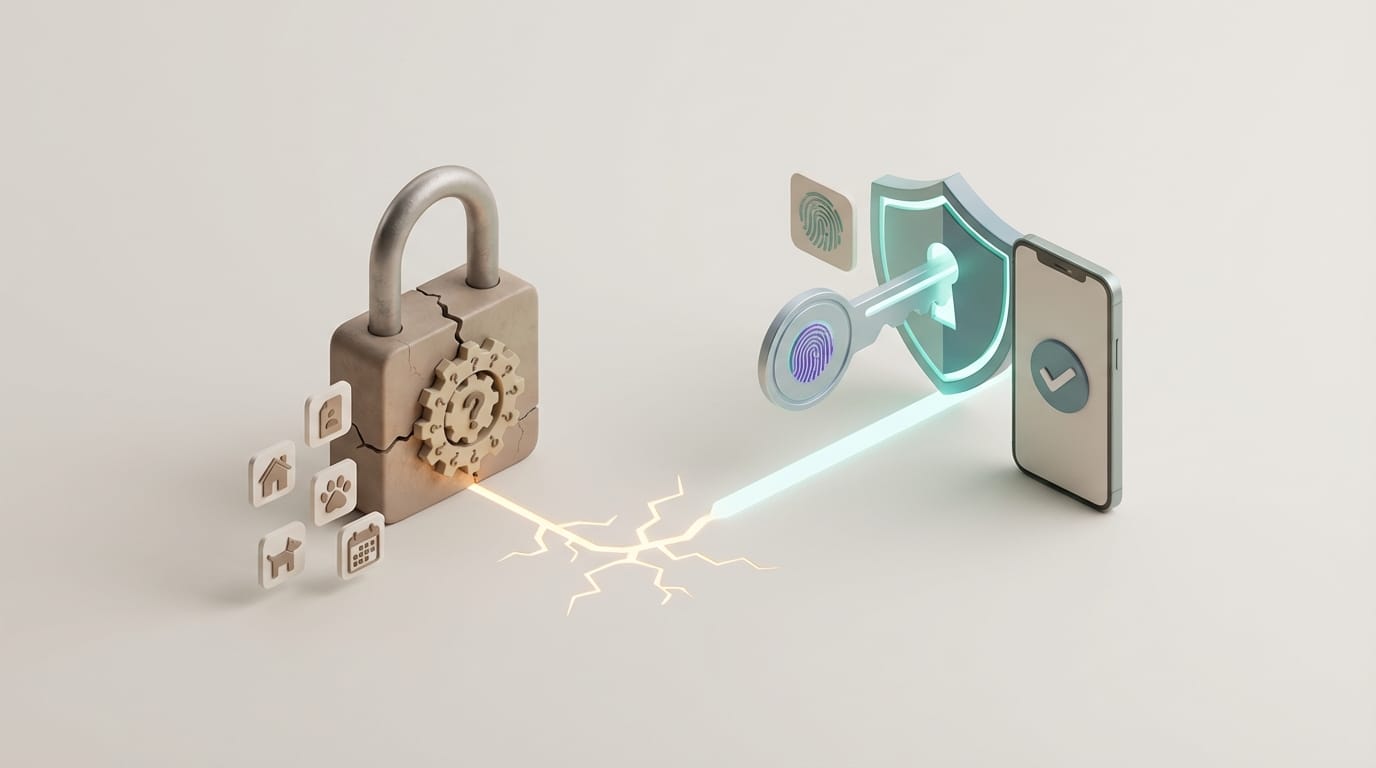
Most users treat security questions as secondary passwords, but these prompts function as permanent backdoors because life facts cannot change after a data breach. Reliance on legacy systems creates massive weaknesses, making the adoption of security question alternatives a priority for everyone. When a mother’s maiden name or a first pet is leaked, that data remains true forever, unlike a password that a user can change in seconds.
The core problem remains that knowledge-based verification assumes life facts are both secret and easy to remember. In reality, they rarely stay secret or memorable. As the digital world moves toward a passwordless future, knowing why these systems fail and what should replace them helps build a safer digital identity. This change is not about adding more layers; it focuses on moving away from static data that attackers can harvest from public records or social media.
The Basic Flaw of Knowledge-Based Verification
Security questions typically function as knowledge-based authentication; this system assumes only the account owner knows specific details about their personal history. A deep gap exists between a secret you create, such as a password, and a fact you remember. Passwords are complex strings that you can rotate at any time, while life facts are simple, static data points that often appear in public records.
How Security Questions Differ from Passwords
A password acts as a shared secret between you and a specific service. If attackers compromise that service, you change the password and the threat disappears. Security questions use found data instead. If a hacker learns your birthplace from a travel site breach, they can use that same data to bypass the recovery screen on your bank account or email provider. No one can reset their birthplace, which means the threat never truly goes away.
The Static Data Trap
The static data trap makes these questions dangerous. Because personal history is unchangeable, any leak creates a permanent hole in your safety. Research shows that even when users try to be clever, they remain predictable. A large study by Google found that 40% of English-speaking users in the US could not recall their answers when needed. Paradoxically, the study also showed that the more memorable an answer is, the easier it is for an attacker to guess; for instance, a hacker has a nearly 20% chance of guessing that a user’s favorite food is pizza on the first try.
How Attackers Bypass Security Questions
Most attackers do not need high-tech tools to bypass security questions because they rely on the trail of digital crumbs people leave behind. Between family tree websites, real estate records, and social media, the answers to common questions about your hometown or high school are just a few clicks away. Harvesting public records is a main part of spotting phishing scams and digital requests that target account recovery.
Social Engineering and Public Record Harvesting
Social media platforms often serve as catalogs for security answers. An “About Me” section or a photo of a first car can provide everything an attacker needs. Furthermore, the rise of automated tools makes it possible for hackers to build full profiles of targets in seconds. If you are protecting digital privacy in an AI world, you must assume that factual details about your life already exist in a database somewhere.
The Predictability of Human Memory
When faced with a security question, the brain seeks the easiest path. People choose common answers because they are easy to remember. According to the Google study, an attacker has a 24% chance of guessing the name of a teacher in just ten tries for certain groups. This predictability makes security questions a weak link that hackers can break through simple guesses focused on common names and places.
Effective security question alternatives for Personal Protection
To secure an account, you must move from what you know to what you have. Modern security question alternatives use physical items or biology to prove who you are, which makes them harder to steal from a distance. These methods turn the recovery process into an active check rather than a memory test.
Multi-Factor Authentication and TOTP
The easiest alternative is Multi-Factor Authentication (MFA) using time-based codes. Apps like Google Authenticator generate a new six-digit code every 30 seconds. Unlike a static answer about your family, these codes expire quickly. They require physical access to your phone, which stops remote attackers who only have your personal data. Recovery rates for codes sent to a device are also much higher; data from Google shows SMS codes work 81% of the time compared to 61% for security questions.
Physical Security Keys
For important accounts, hardware tokens like YubiKeys provide the best protection. These devices use modern standards to provide sign-ins that resist phishing. When you use a physical key, the service checks that the hardware is present before letting you in. This removes the risk of an attacker using gathered knowledge to take over your account, as there is no secret answer to steal or guess.
Backup Codes and Recovery Seeds
Instead of relying on life facts for recovery, many services now provide a list of one-time backup codes when you set up MFA. These are random strings that you should store in a safe, offline place. If you lose access to your primary device, these codes act as your security question alternatives. Because they are random, hackers cannot guess them; because they are unique to each account, a breach at one site does not put another at risk.
Updating Recovery Workflows for IT Admins
For IT professionals, the move away from security questions is now a requirement. Modern standards, including the NIST guidelines, state that systems should not ask users for knowledge-based data. Administrators must design recovery paths that align with these newer standards.
Using Verified Recovery Channels
A verified recovery channel is a pre-confirmed path for getting back into an account, such as a second email or a phone number. Administrators should use these channels instead of life facts. However, certain channels carry risks. Admins should know that phone-based recovery can be a fallback, but it should not be the main method for high-security accounts.
Identity Proofing Services
In large companies where safety is vital, using third-party identity services is a better choice than security questions. These services use state IDs and live face checks to prove a user’s identity before allowing a password reset. This moves the proof from a secret that others might know to a physical identity check, which stops most account takeover attempts.
How to Secure Legacy Accounts
Even with better systems available, many old sites still force you to use security questions. In these cases, the best move is to trick the system by treating the answers like extra passwords. You do not have to tell the truth to a computer; in fact, doing so is often a risk.
Treating Answers Like Random Passwords
If a site asks for your first pet’s name, do not type a real name. Instead, use a random string of characters. This turns a simple question into a strong secret. By providing fake answers, you escape the static data trap. If this fake answer ever leaks, it tells the attacker nothing about your life or your other accounts.
Using Password Managers for Fake Answers
Remembering many fake answers is impossible for the brain, which is why modern security requires dedicated password managers. Most managers have a notes section where you can store these fake answers with your login details. This allows you to stay safe without the risk of getting locked out. Regularly checking these old accounts is part of the strategies to protect personal data in a more hostile digital world.
The transition to security question alternatives reflects a shift in how digital trust works. We are moving away from a world where who you are depends on what you remember, and toward one where your identity stays safe through hardware and math. By treating personal facts as public data and moving toward physical security, we can close the backdoors that have stayed open for years. Your recovery process should be a dynamic system you control rather than a static record for a hacker to find.