
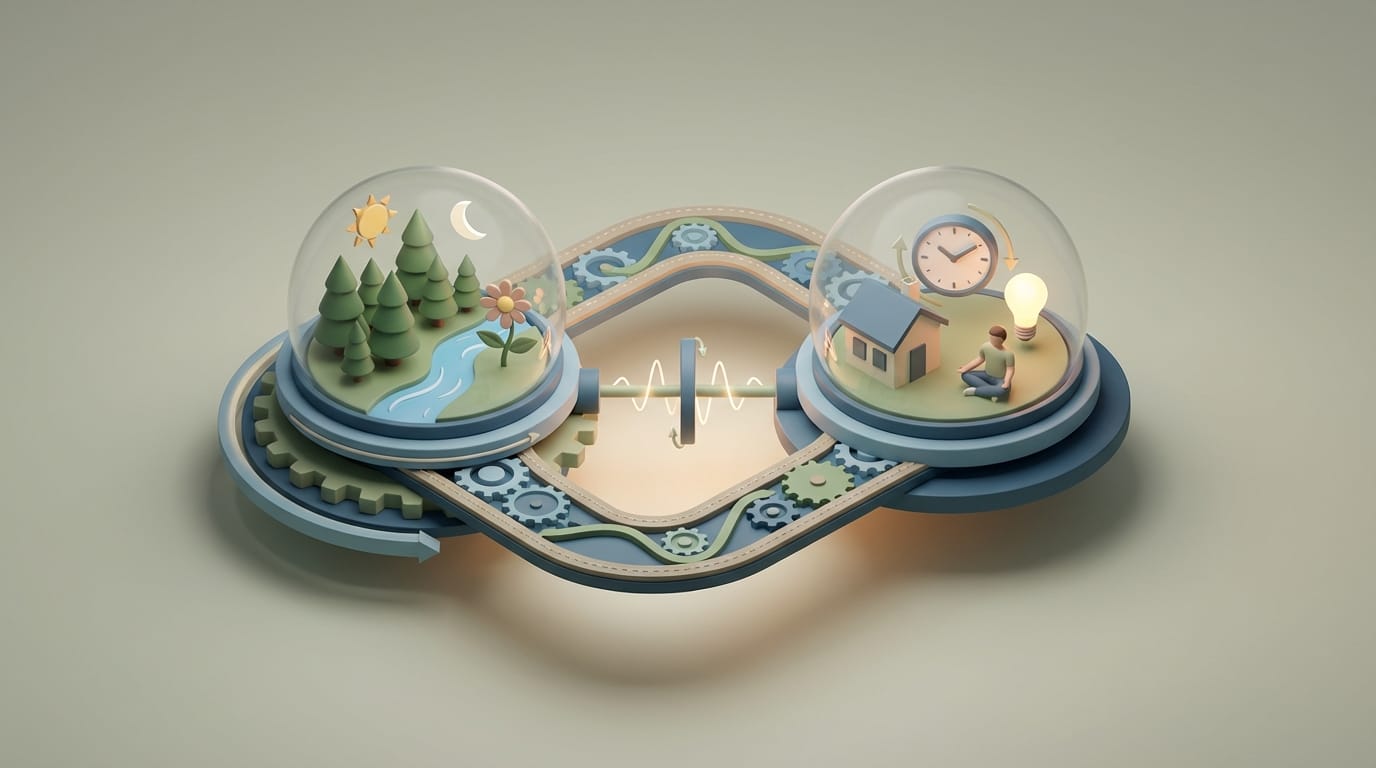
Operating in constant defiance of the natural rhythms of life creates a mounting biological debt that eventually leads to cognitive decline and chronic systemic failure. This is not merely a matter of lifestyle preference or discipline; it is a fundamental mismatch between the high-frequency demands of modern society and the low-frequency mechanical requirements of our planetary heritage. To understand human health is to understand that we are not isolated biological units but nodes in a larger system governed by celestial mechanics. When we ignore these cycles, we do more than just grow tired; we physically desynchronize the thousands of cellular clocks that coordinate everything from DNA repair to neurotransmitter synthesis. These rhythms dictate our existence, and reclaiming them remains a requirement for long-term viability.
The Astronomical Origin of Biological Cycles
Celestial Mechanics as the Earths Master Clock
The foundation of all biological timing is the relationship between the Earth and the sun. Our biology did not develop in a vacuum; it evolved to use the predictable swings of a planet spinning on its axis while orbiting a star. Every living system, from the simplest cyanobacteria to the complex architecture of the human brain, acts as a physical record of these astronomical movements. The primary driver of these cycles is the rotation of the Earth, which creates the 24-hour solar day, but the system grows more complex due to the axial tilt of the planet. This tilt dictates the seasonal shifts in day length and temperature that have shaped life for eons. These mechanics were so central to human perception that ancient cultures developed elaborate stories to track them, a concept explored in this look at how the rotation of the Earth replaced ancient solar myths. Today, we understand these stories as early attempts to map the very systems that govern our internal clocks.
The brain does not just react to the sun; it predicts it. This predictive capacity allows the body to prepare for the energy demands of the day before the eyes even open. If we lived purely by reaction, we would be slow to wake and slow to rest, making us easy targets for predators or environmental shifts. Instead, our cells use a complex internal ticker that keeps time even in total darkness. This internal ticker is not a single clock but a symphony of timers located in every organ, from the liver to the skin. These timers ensure that the liver is ready to process nutrients during the day and the skin is ready to repair its barrier at night. When these timers fall out of sync with the external world, the harmony of the body breaks down, leading to a state of internal chaos that the brain perceives as chronic stress.
How Axial Tilt and Rotation Program Living Systems
Because the environment changes predictably, evolution favored organisms that could anticipate these changes rather than simply reacting to them. This anticipation is hardcoded into every cell through three distinct types of cycles: circadian, ultradian, and infradian. Circadian rhythms are the roughly 24-hour cycles that regulate sleep, temperature, and the release of hormones. These are the most well-known cycles, but they do not act alone. Ultradian rhythms occur more than once a day, such as the 90-minute cycles of human focus or the 4-hour cycle of digestion. Finally, infradian rhythms cover cycles longer than 24 hours. These include the menstrual cycle or the seasonal changes in metabolic rate and immune function, which often become more apparent during events like the arrival of the first day of spring.
These cycles work together to ensure the body uses its energy in the most efficient way possible. During the shorter ultradian cycles, the brain moves through waves of high and low electrical activity, which is why sitting at a desk for eight hours straight often leads to diminishing returns. By honoring the 90-minute pulse of the brain, we can maintain high performance without burning out our mental reserves. Similarly, the longer infradian cycles remind us that our bodies are not meant to perform at the same level in the dead of winter as they do in the peak of summer. The natural rhythms of life demand that we acknowledge these varying speeds, as ignoring them leads to a gradual erosion of our physical and mental health.
How the Circadian System Synchronizes Internal Health
The Role of the Suprachiasmatic Nucleus
The master coordinator of the natural rhythms of life is the suprachiasmatic nucleus (SCN), a tiny region in the hypothalamus consisting of approximately 20,000 neurons. The SCN acts as a central processing unit for light signals received through the eyes. Unlike the signals used for vision, these photons travel through a specialized pathway called the retinohypothalamic tract to tell the brain exactly where the body is in the solar cycle. When the SCN receives blue-frequency light, which is common in morning sunlight, it signals the adrenal glands to release cortisol. This hormone increases alertness, heart rate, and blood pressure to prepare the body for the day.
As light fades, the SCN prompts the pineal gland to secrete melatonin, the hormone that signals the “biological night” and initiates the cellular cleanup process. This transition is delicate and easily disturbed by modern technology. Because the SCN is so sensitive to light, even a small amount of artificial light at the wrong time can halt melatonin production. This is why creating a consistent bedtime routine is so critical for modern health; it serves as a manual override for a system that was designed to respond to the natural sunset. Without this routine, the brain remains in a state of perpetual day, never receiving the signal to begin the deep repair work that only happens during sleep.
Hormonal Cascades Triggered by Natural Light
The transition between cortisol and melatonin is not a simple toggle switch; it is a complex cascade that impacts almost every organ system. During the biological day, the body prioritizes energy use, muscle coordination, and logical thinking. During the biological night, the system shifts toward autophagy, which is the process by which cells recycle damaged components and clear out metabolic waste. This is also when the brain consolidates memories, moving information from short-term storage to long-term networks. If the transition to the biological night is delayed or interrupted, these vital processes remain unfinished.
Modern environments disrupt this cascade through the excessive use of artificial light. High-intensity blue light from screens suppresses melatonin production long after the sun has set, essentially tricking the SCN into believing it is still midday. This prevents the body from entering its repair window, leading to the accumulation of cellular waste that is a hallmark of brain-related diseases and body-wide inflammation. When the brain cannot clean itself, cognitive fog sets in, and the risk for long-term health issues rises. By controlling our light environment, we provide the SCN with the clear signals it needs to manage these hormonal cascades correctly.
The Biophilic Timing of Cognitive Performance
Fluctuations in Alertness Across the Day
Cognitive performance is not a flat line; it follows the sun’s position with remarkable precision. Most humans experience a peak in logical reasoning and focused attention in the late morning, followed by a mid-afternoon dip in alertness. This dip is not a result of lunch or boredom; it is a feature of the circadian rhythm where core body temperature slightly plateaus, causing a temporary lull in metabolic drive. Understanding this “Biophilic Timing” allows us to see that cognitive capacity is physically tethered to celestial mechanics. Research suggests that our brain responses actually vary across the year, with sustained attention peaking around the summer solstice and working memory reaching its highest efficiency during the autumn equinox according to a study in the Proceedings of the National Academy of Sciences.
These findings indicate that our ability to process complex information is influenced by the same seasonal cycles that dictate the behavior of other living systems. For example, during the longer days of summer, the brain may be better suited for tasks that require long periods of focus. In contrast, the shorter days of winter might favor different types of mental processing. By aligning our most difficult tasks with these natural peaks, we can achieve more with less effort. Working against these peaks is like swimming against a tide; you might make progress, but you will exhaust yourself much faster than if you waited for the current to shift in your favor.
The Hidden Link Between Seasons and Brain Function
Beyond the daily cycle, the brain also adjusts to the biological shifts caused by changing seasons. In winter, many humans experience a physiological shift toward energy conservation. This manifests as an increased need for sleep and a subtle change in the balance of brain chemicals, particularly serotonin and dopamine. When we force a high-summer productivity schedule during the depth of winter, we are essentially fighting against millions of years of evolution. Our ancestors used the winter months for rest and reflection, a pattern that allowed them to survive when resources were scarce.
This seasonal tethering is a prime example of why human performance cannot be optimized in isolation. We operate within a system of environmental cues, and when those cues are absent or contradicted by artificial environments, the result is a significant decline in executive function and emotional regulation. Seasonal Affective Disorder (SAD) is perhaps the most visible sign of this desynchronization, but even those without a clinical diagnosis feel the effects. The loss of mood stability and the increase in mental fatigue during the darker months are often just signs that the brain is struggling to find its place in the seasonal cycle. Acknowledging these shifts allows us to adjust our expectations and give our bodies the rest they require.
Why Chronic Desynchronization Breaks Human Systems
The Physiological Cost of Ignoring Natural Cues
Chronic desynchronization, often called “social jetlag,” occurs when our social or professional schedule is out of alignment with our biological clock. This is most common in shift workers, but it increasingly affects the general population due to late-night digital engagement and irregular sleep-wake cycles. The cost of this misalignment is not just fatigue; it is a systemic breakdown. Social jetlag has a profound impact on metabolic health. A recent study found that among individuals with normal sleep duration, social jetlag of just one hour increased the risk of metabolic syndrome by 70%, as reported in the Journal of Health, Population and Nutrition.
This happens because insulin sensitivity is also a rhythmic process. When we eat at times that contradict our internal clock, the body is less efficient at processing glucose, leading to inflammation and weight gain. The digestive system effectively “goes to sleep” at night; forcing it to process a heavy meal at midnight causes a massive spike in blood sugar that the body cannot handle. Over time, this repeated stress damages the pancreas and the liver, paving the way for chronic disease. By simply aligning our eating habits with the natural rhythms of life, we can significantly reduce the strain on our metabolic systems.
Link Between Rhythmic Disruption and Modern Disease
The immune system is also highly sensitive to the natural rhythms of life. Immune cells, including T-cells and natural killer cells, follow a strict schedule for deployment and regeneration. During the day, the immune system is on high alert to protect against pathogens we might encounter while moving through the world. At night, the system shifts toward memory and self-repair. When we are desynchronized, the body remains in a state of high-alert stress, which eventually blunts the immune response. This makes the body more susceptible to infections and slower to recover from physical trauma, which is why athletes must focus on optimizing post-workout recovery as a holistic system rather than just a series of isolated treatments.
The psychological impact is equally severe. Disruptions to the circadian rhythm are closely linked to mood disorders, including depression and anxiety. This is likely because the systems that regulate mood are the same systems that regulate sleep and energy. If the “master clock” is broken, the emotional architecture of the brain lacks the structural stability it needs to function correctly. Chronic lack of sleep and poor timing can lead to emotional volatility, as the prefrontal cortex loses its ability to regulate the amygdala. This creates a cycle where stress leads to poor sleep, and poor sleep makes the brain more vulnerable to stress. Breaking this cycle requires a return to the rhythms that our biology expects.
Reclaiming Harmony Through Environmental Alignment
Practical Steps to Restore Biophilic Timing
Restoring alignment with the natural rhythms of life does not require a return to pre-industrial living; it requires the intelligent management of environmental signals. The most potent signal we can provide the SCN is bright, natural light within the first hour of waking. This sets the timer for the day, ensuring that cortisol is released early and melatonin production begins on schedule roughly 12 to 14 hours later. Even a ten-minute walk outside on a cloudy day provides significantly more light than the brightest indoor bulbs, making it a vital habit for anyone looking to reset their clock.
Equally important is the role of temperature. Human sleep is triggered not just by darkness, but by a drop in core body temperature. By cooling our environments and reducing physical activity in the evening, we signal to the brain that the biological day has ended. This thermal cue is essential for entering the deep sleep cycles required for cardiovascular health and cognitive maintenance. The body needs to shed about two to three degrees of core temperature to initiate deep sleep. If the room is too warm or the body is still buzzing from a late-night workout, the brain will struggle to enter the restorative phases of rest, regardless of how long you stay in bed.
Designing Living Spaces for Rhythmic Health
To truly reclaim our biological heritage, we must structure our lives to mirror natural energy peaks. This means prioritizing deep, cognitively demanding work during the morning peak and reserving administrative or physical tasks for the afternoon dip. It also means respecting the seasonal shifts by allowing for slightly longer sleep windows in the winter months. Simple changes in how we manage our surroundings can have a massive impact on our long-term health and productivity.
- Light Management: Use dim, warm-spectrum lighting in the evening and maximize sunlight exposure during the day to keep the SCN on track.
- Nutritional Timing: Align eating windows with the sun because digestion is most efficient when the body is in its active metabolic state.
- Temperature Regulation: Keep a cool sleeping environment (roughly 65°F or 18°C) to facilitate the body’s natural nocturnal temperature drop.
By treating these rhythms as non-negotiable requirements for health, we move from a state of constant biological friction to one of systemic harmony. The goal is not to hack the body, but to provide it with the environmental context it was designed to thrive in. Our cellular health is physically tethered to celestial mechanics; we are part of a clockwork universe that does not stop for our deadlines. Understanding that going against the grain incurs a biological debt provides a new framework for making decisions about how we work, eat, and sleep. As we move further into a world of constant connectivity, the most valuable skill may be the ability to selectively disconnect and listen to the ancient pulses that still dictate our potential. Your current exhaustion might not be a matter of workload, but a matter of timing.