
The Technical Path to Multi-Bank Management
Managing multiple bank accounts often feels like a second job until you realize the frustration comes from the lack of a unified interface. Effective multi-bank management allows you to move beyond messy spreadsheets by treating your financial setup as a single system. By shifting your focus from checking accounts to monitoring a whole network, you can reduce the mental drain that leads to low interest rates and missed chances. This change requires moving away from manual work and toward a structural approach that uses modern data rules to maintain a clear view of every asset.
The main problem with modern finance is not a lack of tools, but the friction of the silo effect. Every bank wants to be your main home, yet the best strategy for a smart household often involves using different banks for their specific strengths. Handling this complexity requires a clear understanding of how to bridge these gaps without risking security or losing your peace of mind.
Why scattered banking creates hidden friction for multi-bank management
The primary cost of keeping funds across different banks is the mental energy required to track your net worth. When you must log into five different apps to check a single bill or a balance, you lose more than time; you burn through your limited energy for making good choices. This friction often results in financial ghosting, where people leave accounts unmonitored for weeks. This neglect leads to missed fraud charges or forgotten subscriptions that drain your wealth over time.
Beyond the mental cost, scattered banking leads to yield leakage. In an environment with high interest rates, leaving even a few thousand dollars in a basic checking account instead of a high-yield savings account is a clear loss. Without a unified view, these idle balances stay hidden. You might feel short on cash in your main account while several other accounts hold money that could be earning more. Multi-bank management fixes this by showing these gaps. When you see the difference between your total cash and your immediate bills on one screen, you can move lazy money into better spots. This oversight ensures your capital always works where it provides the most value, whether that is for earning interest or paying down debt.
The mental load of different login screens
Every banking app has a unique layout, security steps, and alert system. Navigating these different worlds creates a form of technical debt for your brain. If you constantly switch between apps to check if a transfer arrived or a bill was paid, you are acting as a manual bridge between databases that do not talk to each other. This manual labor is the opposite of efficiency.
Finding lost interest in unmonitored accounts
Yield leakage happens when the work of moving money feels harder than the benefit of the interest you earn. If it takes ten minutes to log in and move funds, many people will ignore a small interest difference. However, when you see that difference across several accounts on one dashboard, it can represent thousands of dollars each year. Seeing the total makes the effort to fix your system much easier to justify.
How open banking protocols enable secure integration
The foundation of multi-bank management is the shift from screen scraping to Open Banking APIs. In the early days, apps would scrape your data by logging in as you, which meant you had to share your main passwords. This was a security risk that created a single point of failure for your entire financial life. If that one app was hacked, your whole wallet was at risk.
Modern systems use read-only tokens. When you link a bank to a dashboard today, you go to your bank’s official site to approve a token. This token tells the bank to allow the app to see your history, but it does not allow the app to move money or change your settings. This split is vital for safety; even if the dashboard had a problem, a hacker would only see a list of transactions, not gain the able to empty your accounts. Currently, regulations that standardized secure financial data sharing ensure that your data travels through encrypted paths rather than through shared passwords. This shift makes it safe to keep a single dashboard that monitors every account without increasing your risk.
How read-only access keeps you safe
The connection between your bank and your tool is a one-way mirror. It can show the state of your money with great detail, but it cannot change anything. This separation is a core rule of secure design. It lets you bring your info together while keeping your actual money behind the bank’s own walls. Modern standards are also much faster and more reliable than older methods. They use authentication steps (similar to how you might sign into a site using a major tech account) to ensure your private login never touches the third-party app. This follows the best practices found in this guide to protecting digital privacy.
Selecting one dashboard as your financial source of truth
To succeed at multi-bank management, you must choose one main interface. This is the single screen you check regularly. It should not be your bank app; it should be an aggregator that pulls data from every checking account, credit card, and loan. Using one interface provides a steady view of your data, allowing you to see your net cash flow across the whole system rather than just one balance. When picking an aggregator, look for services that focus on fast syncing and smart sorting. Tools like Monarch Money, Copilot, or Quicken Simplifi have become standards because they use several data providers to cover almost every bank. These tools strip away the ads from individual banks and give you raw data you can use.
A strong dashboard should allow you to perform systematic financial health checkups without typing in data by hand. By automating your history, you move from wondering where your money went to a state where you see upcoming bills and idle cash before they become an issue. This move from reactive to proactive is the key to long-term wealth.
Designing a hub and spoke model for account structure
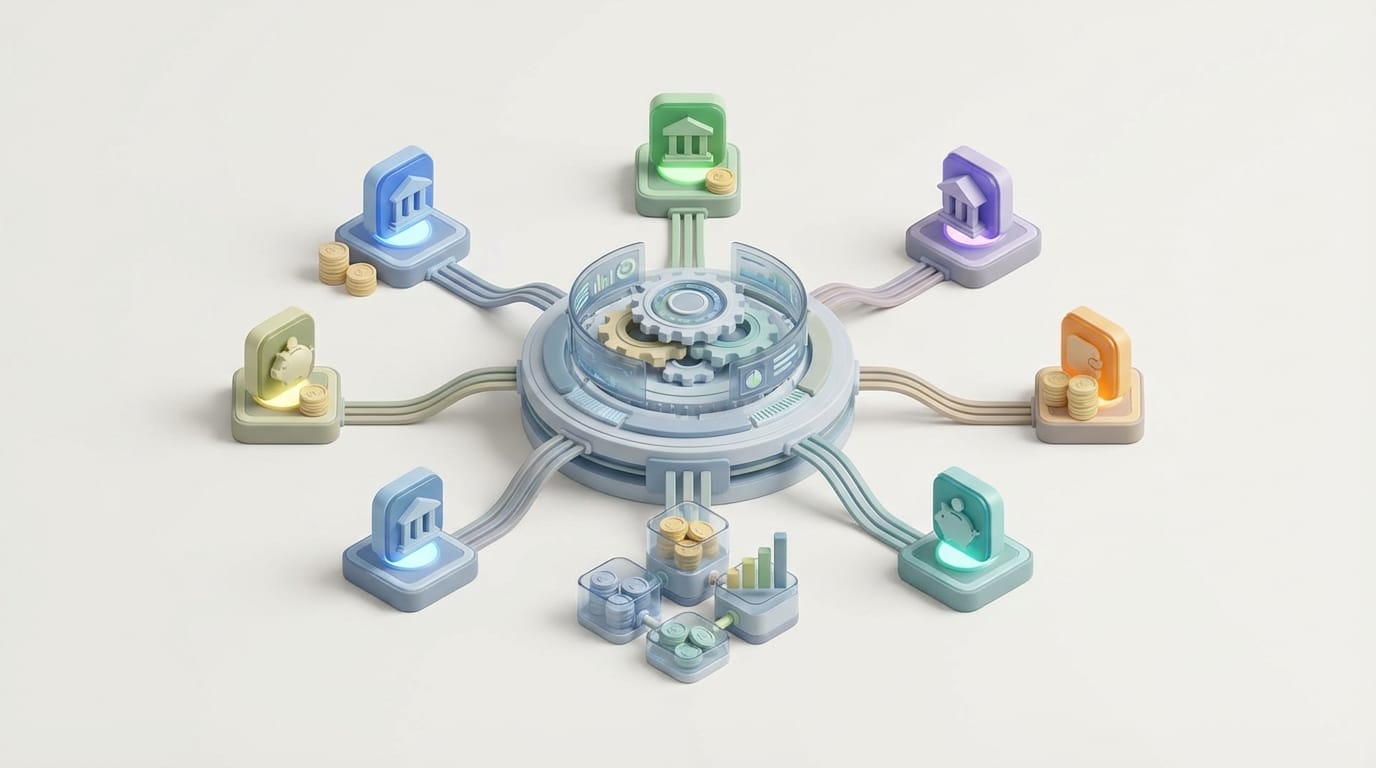
The best way to organize your accounts is the Hub and Spoke model. In this setup, you pick one main checking account as your Hub. All income (paychecks, dividends, and side pay) flows into this center. From here, money goes out to various Spokes. These are specialized accounts for things like high-yield savings, tax money, or investments. The Hub is where your daily spending lives. It handles your rent, light bills, and grocery shopping. By keeping these in one place, you only manage one list of bills.
The Spokes are where you look for the best results. You might have a Spoke at a digital bank for your emergency fund and another at a brokerage for stocks. This model stops you from mixing funds, which often leads to spending money you meant to save. When your travel fund is in a different bank, you are less likely to spend it on a new phone. You can apply the same logic found in organizing your life with basic blocks: by creating clear containers for different tasks, the system manages itself and becomes much easier to fix when something changes.
The role of the central checking hub
Your Hub should be at a bank with high reliability and fast transfer speeds. Since this account moves all your money, it does not need the highest interest rate; it needs the best pipes. Look for features like fast fraud alerts and easy direct deposits. This account is the engine of your financial machine, so it needs to be dependable above all else.
Using spokes for better savings
Spokes are where you find the best rates. Because you do not need to log into these accounts every day (since your dashboard tracks them), you can pick banks based only on their rates or perks. This allows you to benefit from the price wars between banks without the headache of moving your entire life every time a new offer pops up. You get the best of both worlds: stability at the Hub and growth at the Spokes.
Overcoming the technical maintenance of multi-bank management
The biggest challenge is not the first setup; it is keeping the digital links alive. Extra security steps like Multi-Factor Authentication are necessary, but they can cause links to break. This usually happens when a bank updates its site or requires a fresh login every few months. To handle this without stress, treat account care like a quick system update. Instead of getting annoyed when a link breaks, set a time once a month to refresh any old tokens. Most modern dashboards will show exactly which account is offline and give you a link to fix it.
Using a dedicated password manager is vital here. When you need to relink an account, you should not be looking for a password. You should be able to fill your info and verify the code in seconds. If you see these tasks as a routine check rather than a failure, the friction of the system stays low. Maintenance is just the small price you pay for having a high-performing financial system.
Automating the flow between separate banking institutions
The final step in mastering multi-bank management is automation. Once your Hub and Spoke model is set and your dashboard is syncing, you can take yourself out of the monthly budget. Set up automatic transfers from your Hub to your Spokes to happen the day after your paycheck arrives. This ensures you save before you have the chance to spend. Advanced users can even set rules where any extra money in a checking account automatically sweeps into a savings account at the end of the month.
The goal of automation is to make your strategy part of the background. When the system works, you are not doing your finances; you are just checking the dashboard to see that everything went as planned. Recent data shows the rise of open banking transactions continues because people want this type of smooth, real-time control. This level of management was once only for large companies, but it is now available to anyone with the right tools.
Mastering these systems is about reclaiming the interest you deserve and the clarity that a messy financial life takes away. When you treat your accounts as parts of a larger machine, you stop serving your apps and start engineering your wealth. By bringing your data into one truth and automating the flow of cash, you turn complexity into a major advantage. The real question is no longer if you should have many accounts, but if you have the system to make them work for you. As technology improves, the work of managing these systems will only get easier. Transitioning from a manual spreadsheet to a high-quality dashboard is the best way to stop paying the hidden costs of a scattered wallet.