
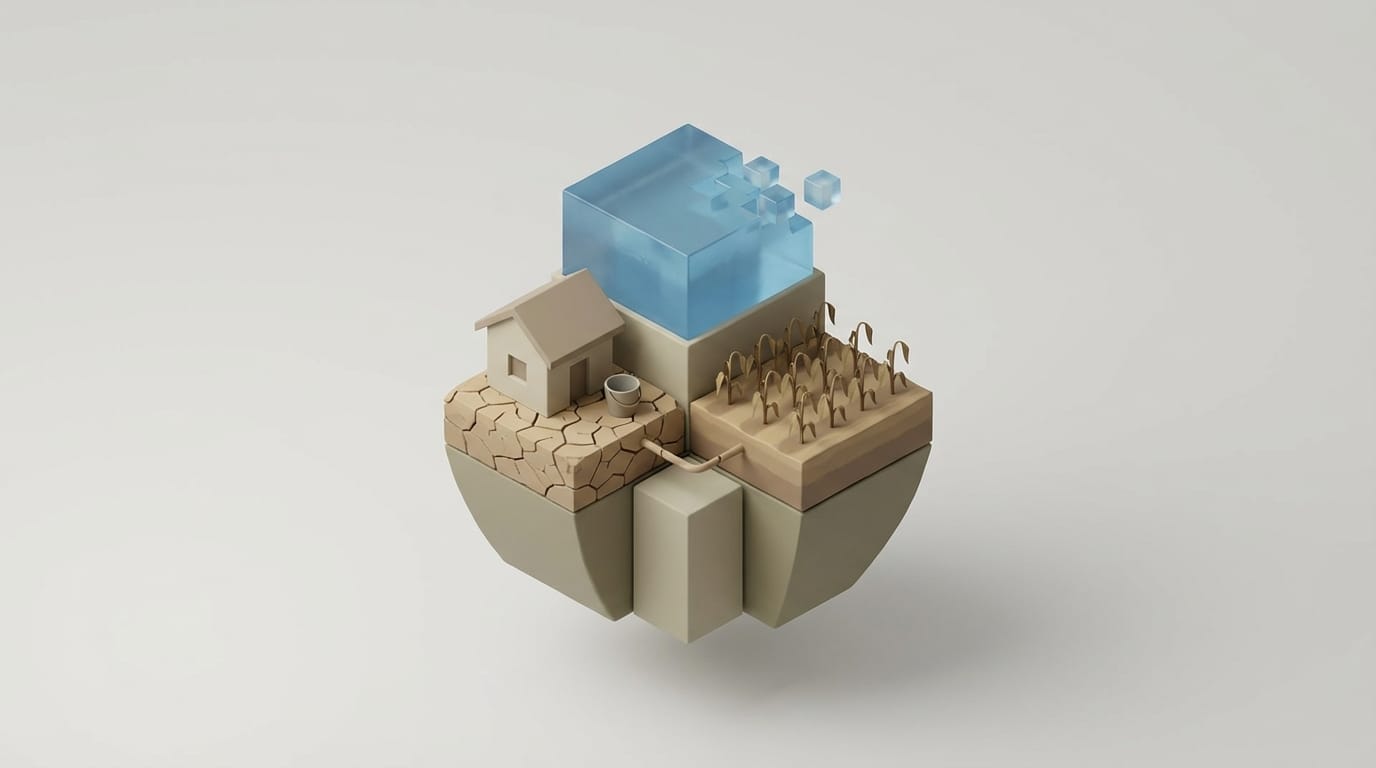
While many view water scarcity as a seasonal shortage, the global system is sliding toward water bankruptcy. This state occurs when the planet can no longer balance its water accounts. The water scarcity impact on food systems reaches far beyond dry climates; it represents a failure in how we manage the water that determines what we eat and what it costs. Today, the mechanics of this system are clear to the average shopper as grocery prices rise in response to dry wells and failing irrigation networks.
Understanding the current state of our food and water needs requires moving beyond the idea of droughts as isolated weather events. We must view water as a form of natural wealth that people are spending too fast. When we treat a finite resource as an infinite tool, the system does not just decline slowly; it breaks in sudden bursts along the supply chain. These breaks are now changing daily habits, influencing everything from how cities grow to what people put on their plates.
The move from manageable shortages to bankruptcy marks a shift in how we must govern our resources. Global leaders are moving away from simple conservation toward a total economic reset. This reset involves admitting that pumping water faster than rain can refill it is a math error that temporary fixes cannot solve.
Defining the Shift from Water Stress to Water Bankruptcy
To understand the current crisis, one must see the difference between water stress and water bankruptcy. Water stress is a state of high pressure where demand exceeds supply, but the condition remains fixable through better care or rain. It is a temporary strain. By contrast, water bankruptcy happens when we pump more than rain replaces, causing a loss of natural wealth that is too costly to fix. This permanent loss changes the map of where food can grow.
Identifying the Breaking Point of Hydrological Systems
Water systems have a storage capacity, much like a battery holds power. When we pull water from an aquifer, we often take liquid that took thousands of years to gather. Once we pump faster than the earth refills the space, the water table drops; the energy needed to pump what remains then rises fast. Eventually, we reach a physical limit where the water is too deep to reach or the ground itself collapses, losing its ability to hold water in the future.
This failure is often invisible because it happens deep underground. In places like the Central Valley in California or the Indo-Gangetic Plain, the land is sinking as the empty spaces in the earth crush under their own weight. This process, known as subsidence, is the physical sign of an overdrawn account that can never be repaid. This change is often driven by heat shifts explained in our guide on the greenhouse effect as a wavelength filter, where trapped heat dries the soil and strains these fragile reserves.
Why Current Conservation Efforts Often Fall Short
Most current efforts focus on efficiency, such as using drip lines or better faucets. While these steps help, they often fail to stop the total loss of water. In many cases, saving water in one spot leads to an efficiency trap where the saved water is simply used to plant more land. The total amount used stays the same or even grows, even though the tools are better.
Managing bankruptcy requires a hard limit on total use, no matter how efficient the tools are. This means admitting that some regions can no longer support thirsty crops or heavy industry. Moving beyond temporary saves requires a change in how we value water as an asset. We must stop trying to do more with less and start living within the system’s hard limits.
The Direct Connection Between Hydrology and Farming
Farming is the largest user of fresh water, taking about 70 percent of what we pull from the earth. This high use makes the food supply weak when water levels change. When water drops below a certain point, the physics of growing food shifts; pumps lose their grip, salt builds up in the soil, and crop yields fall fast. This chain reaction shows how the water scarcity impact on food systems threatens the stability of every meal.
How Irrigation Failures Disrupt Local Food Supply Chains
Irrigation keeps the food system steady, allowing farmers to grow crops even when it does not rain. However, as aquifers fail, this safety net disappears. In parts of India and the Middle East, farmers who once relied on steady wells are seeing them go dry. When irrigation fails, the local supply chain loses its buffer, leading to immediate shortages of fresh vegetables and grains.
Basic crops like rice and wheat are sensitive to these shifts. Rice usually grows in flooded fields that need huge amounts of water. As water becomes scarce, the cost of keeping these fields wet becomes too high. Farmers are often forced to switch to cheaper, dry-weather crops or stop farming entirely. This triggers a wave of economic pain in small towns and rural areas.
The Hidden Costs of Importing Virtual Water
One complex part of the global food system is the virtual water trade. This term refers to the water used to grow a crop, which is then sent away when that crop is shipped. For example, when a country exports rice, it is effectively exporting its groundwater. A single ton of wheat needs roughly 1,000 cubic meters of water to grow; dry regions often import millions of tons of grain to save their own fresh water for other uses.
While this trade helps dry nations survive, it creates a dangerous tie. It also puts pressure on the nations selling the food, who often drain their own water to support people far away. As water bankruptcy spreads, these food-selling nations may stop exports to save their own supplies, leading to sudden global food crises.
Why Water Scarcity Impact on Food Systems Affects Global Prices
Markets react fast when the costs of growing food change. When water becomes hard to find, the cost of food rises to reflect that risk. This is not just a local problem; because the food system is global, a dry spell in a major farm state can cause price spikes for shoppers thousands of miles away. The water scarcity impact on food systems is a main cause of high food prices today.
Tracking the Economic Chain from Dry Wells to Grocery Aisles
The economic chain starts at the farm, where higher costs to pump water or lower harvests increase the price of every pound of food. These costs move through the packers, the shippers, and finally to the store. For a look at this fragile system, you can read about why groceries are getting so expensive, which explains how resource loss drives up what you pay at the register.
Scarcity also forces people to use expensive tech fixes. Cleaning salt from sea water, recycling waste water, and drilling deep wells all need a lot of power and money. These fixes keep the water moving, but they raise the floor for food prices. We are moving away from an era of cheap food grown with free water toward a time where every calorie has a clear price tag. This shift is part of the larger story of how climate change drives food prices through system-wide chain reactions.
The Fragility of Export-Oriented Farming in Arid Regions
Many nations build their economies around selling thirsty crops like cotton or nuts grown in dry areas. This model is weak. While it brings in cash now, it drains the nation’s water for a small profit. When the water runs out, the financial base of these regions falls apart, leading to farm bankruptcies and job loss.
This risk grows as markets change. If a nation must stop selling a crop because of water loss, it loses its main income just as it needs to buy more food to replace what it can no longer grow. This double hit to the economy can lead to national debt and social unrest, proving that water care is a core part of national safety.
Assessing the Toll of Water Scarcity on Individual Lifestyles
Systemic water failure eventually reaches the home, changing how people live their lives. In many parts of the world, a faucet no longer guarantees a flow of water. Instead, water access is becoming a scheduled and guarded part of the day.
The Reality of Living Under Periodic Water Rationing
Water limits are becoming common in cities across the globe. When the state controls every gallon, daily life must change. People learn to shower with buckets to save water for toilets; laundry happens only on certain days; and home gardens become a thing of the past. This constant mental load of saving every drop changes how people feel about their homes and their leaders.
This limit also hurts school and work. In areas without pipes, the task of finding water usually falls on women and children. As local wells dry up, they must walk further and wait longer, losing time they would otherwise spend in school or at a job. This keeps families in poverty and slows down the progress of entire towns.
Long-term Health and Hygiene Risks of Limited Access
There is a direct link between water scarcity and the spread of sickness. When water is hard to find, cleaning standards fall. People might use dirty water to wash food or cook, leading to outbreaks of disease. When farm water is dirty or used too many times without cleaning, it can put harmful germs or metals into the food supply, creating health risks for everyone who eats it.
The mental weight of not having enough water is also large. Constant worry about water for the next meal or bath creates steady stress. This stress hurts how neighbors get along, often leading to fights over small shared pools of water. Water is the base of the bond between a person and their government; when the water stops, that bond begins to break.
Treating Water as Natural Capital to Prevent Systemic Failure
To avoid total bankruptcy, we must change how we value this resource. This means moving from a model where water is free and infinite to one where we see it as a finite asset with a clear price and a need to be refilled. This shift is the only way to soften the water scarcity impact on food systems over the long term.
Moving Toward a Total Economic Reset of Water Valuation
Valuing water as natural wealth means tracking it on a national balance sheet. Just as a business tracks its cash, a nation must track its water reserves. This value should include the work water does to keep soil healthy and keep the climate steady. When water has a high price, wasteful habits become too expensive, forcing people to invest in better systems.
This shift needs a change in farm rules. Governments should stop paying for thirsty crops in dry spots and start rewarding farmers who help refill the water table. Tools like real-time plant monitoring allow for precise watering that gives a plant only what it needs. This moves us toward a circular water system where every drop is tracked, used, and returned to the earth in a clean state.
Policy Shifts Required to Restore Replenishment Cycles
Fixing the water cycle requires large changes to the land. This includes planting forests to help the soil hold rain, fixing wetlands to act as filters, and pumping extra rain back underground. These are not small fixes; they are large projects that need steady political will and countries working together.
Finally, we must put water care into all parts of economic planning. Food, power, and city growth can no longer be planned in separate rooms. Every new housing tract or factory must have a water budget that proves it can work without draining the local supply. By treating water as the hard limit of our systems, we can build a society that respects the boundaries of the planet. This leaves us with a critical question: as the price of every gallon and every calorie rises, how will we choose to share the shrinking wealth of our water?