
The Personalized Future of Live Sports Production
Most broadcasters view artificial intelligence as a tool for cutting costs, but the true shift in AI in sports production lies in the end of the “one-to-many” broadcast model. For decades, the industry operated under the constraint of a single master feed; today, the system is shifting toward thousands of parallel, unique user sessions. Understanding this transition requires looking past the hype and into the architectural changes of how live signals are captured and distributed to a global audience.
This shift is not merely about adding a new layer of software to existing workflows; it is about rebuilding the production stack from the ground up. Modern production relies on agentic systems that do more than follow scripts because they understand the context of the game itself. When the underlying logic of a broadcast changes from manual execution to autonomous orchestration, the relationship between the fan and the live event changes as well.
The Transition to Agentic Live Production Systems
The industry is moving beyond simple automation, where a script might trigger a graphic based on a data feed, toward agentic AI that makes independent production decisions. In a live sports context, an agentic system acts as an autonomous operator that monitors thousands of variables simultaneously. It can predict an upcoming high-intensity moment and prepare the necessary camera angles and data overlays before the action occurs, ensuring the most compelling footage is always ready for the viewer.
Traditional automation is rigid; it follows a set of pre-defined rules that often break when the game moves outside of expected patterns. Agentic systems, however, use machine learning models that have been trained on the deep tactical rules of specific sports. These systems understand that a specific player movement in basketball signals a high probability of a fast break, allowing them to adjust the production priority to favor tracking that specific athlete without human intervention.
These systems are increasingly capable of real-time operational adjustments that previously required a room full of directors and technical assistants. Instead of a human choosing every cut, the AI evaluates the “story value” of multiple camera feeds; it selects the shot that captures the momentum of the game based on historical patterns of audience engagement. This represents a shift from predictive analytics to real-time execution, where the AI is not just telling us what might happen but actively building the broadcast as it unfolds.
How AI in Sports Production Replaces Manual Tracking
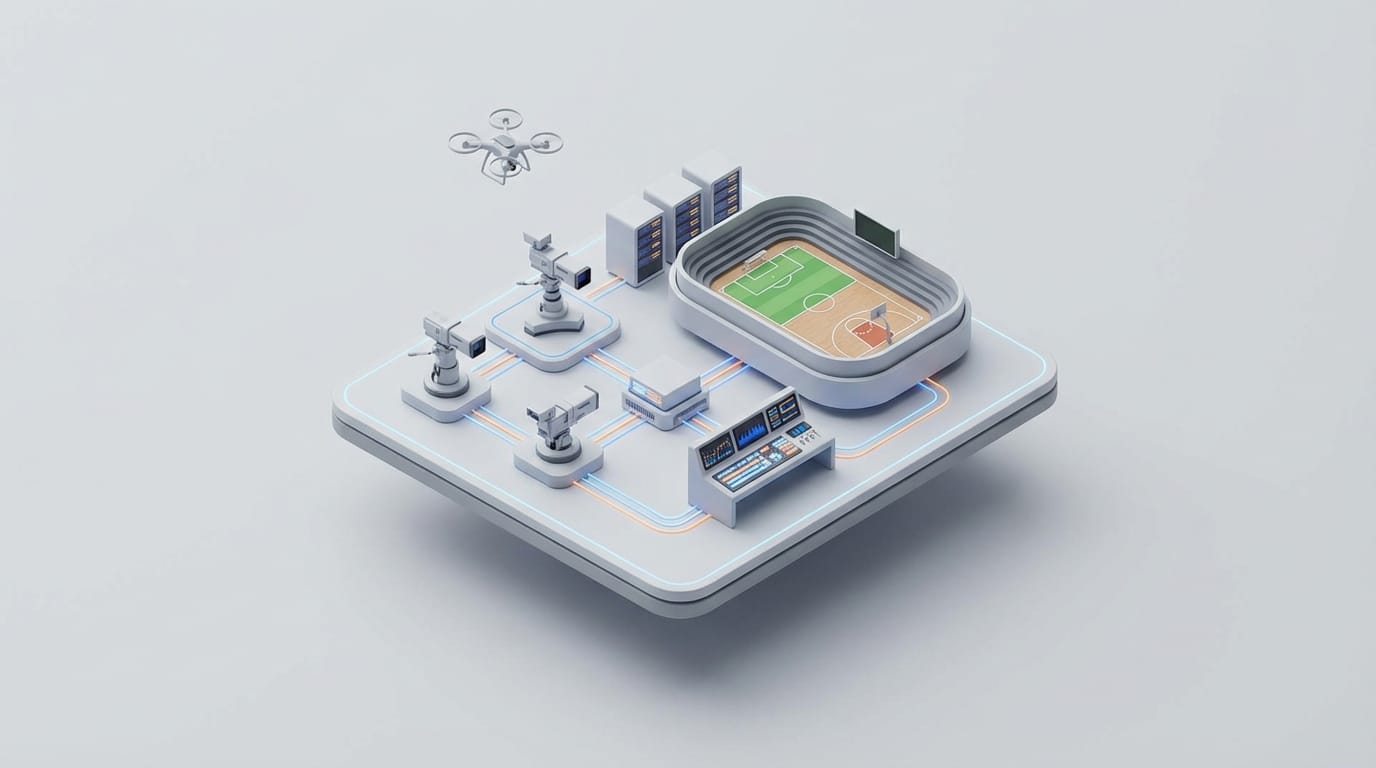
The physical footprint of a live broadcast is shrinking as automated camera systems replace traditional manual tracking. Computer vision technology, often paired with LiDAR and high-speed optical sensors, allows for precise player and ball tracking without the need for a dedicated operator for every lens. These systems create a digital twin of the field in real-time, which allows the production software to virtually move a camera to any position within the stadium.
Virtual cinematography is now at a point where AI can orchestrate multi-angle coverage based on action density. In a soccer match, the system might track 22 players and the ball with millimeter accuracy; it then calculates which of the robotic cameras has the best unobstructed line of sight. According to analysis by WSC Sports, these autonomous pipelines generate thousands of custom highlight clips almost instantly, which is a task that previously took human editors hours of manual labor.
Reducing the physical footprint of camera crews is not just about cost; it is about access. Smaller venues and lower-tier leagues that could not afford a full production crew can now deploy a small array of automated cameras to produce a professional-quality stream. This democratization of high-end production values is a direct result of how AI in sports production manages the complexities of live tracking and orchestration without the overhead of human operators.
Using Real-Time Data to Enhance On-Screen Storytelling
Modern sports broadcasting has evolved from simple score bugs to complex data-driven narratives. Systems like the “Dragon” platform from Genius Sports now capture thousands of data points per player every second, allowing for the instant generation of graphical overlays that predict the probability of a successful play. When a viewer sees a catch probability percentage appear over a wide receiver in mid-air, they are witnessing a real-time calculation of physics and historical performance.
These advanced metrics are integrated directly into the live feed to provide context that was previously invisible to the naked eye. AI identifies key moments for social media distribution within seconds; it uses audio signals like crowd noise and commentator pitch alongside visual triggers like a ball crossing a goal line. This metadata does not just improve the live experience; it changes the searchability of sports archives, making every moment of every game indexed and retrievable by specific tactical events.
The use of AI here is similar to how AI graphics upscaling replaces traditional resolution in gaming; it fills in the gaps where raw data or footage is insufficient to tell the whole story. By synthesizing player tracking, ball velocity, and historical trends, the broadcast provides a layer of tactical insight that transforms the viewer from a passive observer into an informed analyst. This deep integration is also explored in our guide on AI in sports performance analytics, which details how teams use this same data to win on the field.
Moving From One-to-Many to Personalized Live Streams
The most profound shift in the industry is the transition from a single broadcast master to a one-to-one model. In the past, every person watching a game saw the exact same camera angle and heard the same commentator; today, AI enables thousands of unique user sessions for a single event. A fan can now choose a player-focused camera that follows their favorite athlete exclusively; meanwhile, another viewer might opt for a data-heavy overlay that prioritizes betting odds and advanced tactical maps.
Personalization is an engagement engine that keeps viewers watching longer. Statistics show that viewer retention can increase significantly when content is tailored to individual preferences. AI handles this by generating multiple commentary tracks in different languages or dialects; it can even create niche commentary focused on specific fantasy sports metrics. This level of customization allows a single live signal to be sliced into many content variations, ensuring that every demographic finds a version of the game that resonates with them.
This personalized approach extends to advertising as well. Using agentic AI, broadcasters are testing systems that can autonomously buy and insert live sports ads based on individual viewer demographics. Instead of a generic beer commercial during a break, one viewer might see a local gym promotion while another sees a travel deal. This ensures that every ad second is optimized for the highest possible return on investment without disrupting the flow of the game.
How AI Reduces Operational Friction in Remote Production
The rise of cloud-based control rooms has significantly reduced the reliance on massive Outside Broadcast trucks and large on-site staff. By moving the heavy lifting of video processing to the cloud, production teams can manage a global event from a central hub. AI plays a critical role here by managing bandwidth allocation and synchronized data flows; it ensures that high-definition feeds reach the viewer with minimal latency regardless of the distance from the venue.
Reducing operational friction allows for a flexible approach to broadcast logistics. When the production logic is software-defined, scaling up for a championship game or scaling down for a local collegiate event is a matter of adjusting cloud resources rather than moving physical hardware. This is particularly beneficial for lower-tier sports that previously struggled with the cost of streaming; they can now achieve broadcast-grade quality through automated cloud workflows.
Latency management is perhaps the most technical challenge in this shift. To maintain a live feel, the system must synchronize video feeds with real-time data overlays and remote commentary. This requires a level of network precision similar to why ethernet beats wifi for gaming latency; AI monitors the health of the connection and adjusts bitrates in real-time to prevent buffering. This sliding scale approach to production ensures that the viewer experience remains consistent even as network conditions fluctuate.
The Future Standard for Sports Broadcast Performance
As we look toward the long-term roadmap for AI-driven sports media, the intersection of broadcast technology and officiating will become increasingly fluid. Systems like FIFA’s semi-automated offside technology already use AI to track player positions and alert officials within seconds. This impartial fifth referee improves the fairness of the game while simultaneously providing broadcasters with the definitive data needed to explain complex calls to the audience.
Preparing for this future requires a structural shift in how sports organizations view their technical infrastructure. The next generation of fan engagement will not be built on better cameras alone; it will be built on the ability to process and personalize data at scale. Organizations that successfully integrate AI in sports production into their core workflows will find that personalization is their ultimate competitive advantage. It allows them to own the relationship with the fan in a way that traditional linear TV never could.
There are ethical considerations regarding automated decision-making. Whether it is an automated strike zone in baseball or a VAR decision in soccer, the role of the human official is being redefined as an overseer of AI logic. This mirrors the broader trend in how sports fouls and violations enforce fair play; the rules remain the same, but the mechanism of enforcement is becoming more precise and less prone to human error.
The transformation of live sports production from a static, manual craft into an autonomous, personalized experience is the current operating reality. By shifting the focus from what the camera sees to what the viewer wants, the industry is solving for engagement in an era of fragmented attention. The true value of AI in this system is not found in the clips it cuts or the costs it saves; it is found in its ability to treat every fan like they are the only one watching.
As production workflows become software-defined, the boundary between the stadium and the screen will continue to blur through digital twins and augmented layers. The question for broadcast executives is no longer whether to adopt these systems, but how quickly they can rebuild their operations to support a one-to-one world. Modern broadcasters must be prepared to manage a broadcast that is as unique as every individual fan in the audience.