
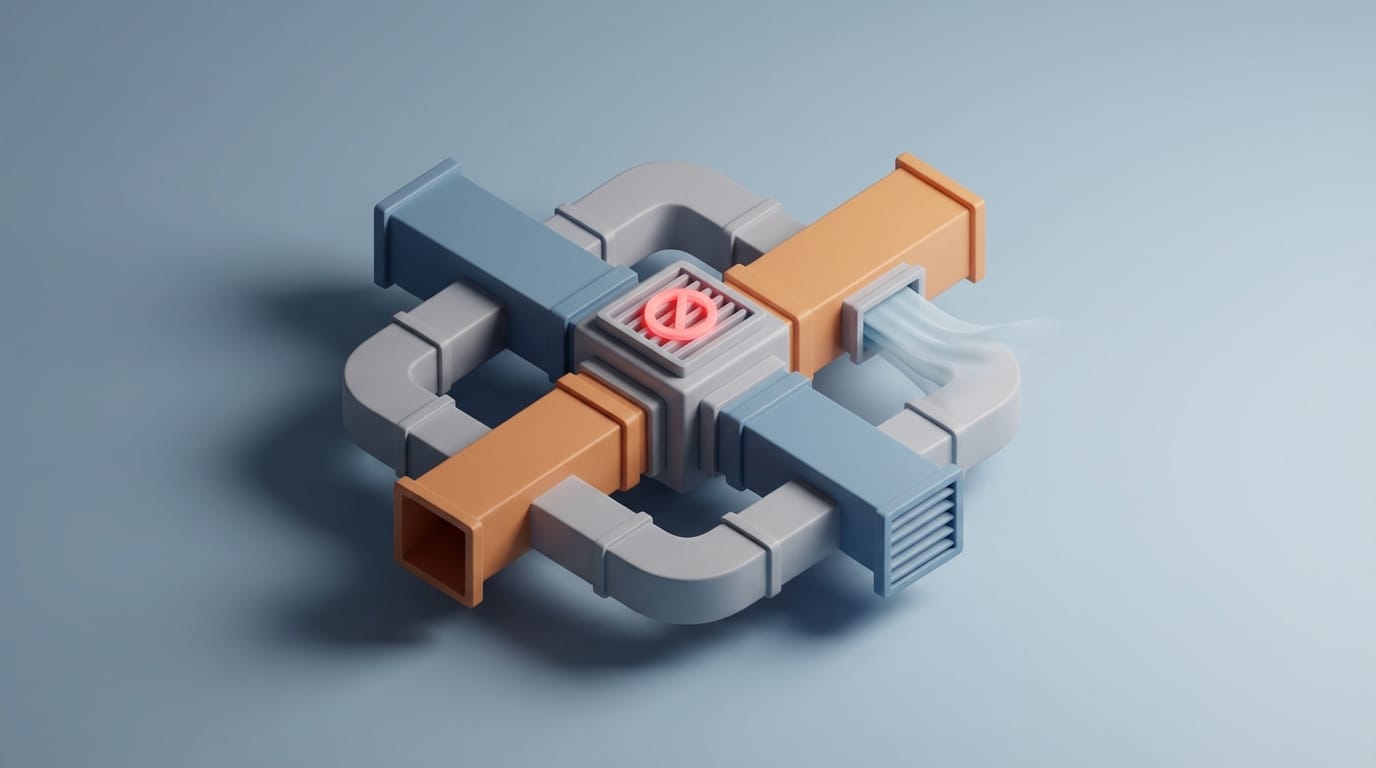
Many homeowners believe that closing vents to save energy in rooms they rarely use reduces utility bills, yet this common habit often leads to expensive equipment repairs. While the intent is to redirect air to occupied spaces, the practice ignores the engineering physics that govern modern heating and cooling systems. Understanding why this method backfires requires looking at the home’s climate control as a precisely balanced machine rather than a collection of independent rooms.
When a homeowner closes a vent, the furnace or air conditioner does not produce less conditioned air. Instead, the obstacle forces the air to find another path. In a forced-air system, the blower motor moves a fixed volume of air based on the ductwork’s design. Blocking an exit point creates backpressure that ripples through the entire network, putting stress on parts that cannot handle the resistance. The result is a cycle where the equipment works harder, consumes more power, and sustains physical damage.
The Common Misconception of Air Redirection
The habit of closing vents often stems from a flawed comparison to plumbing. In a water system, closing a tap in one bathroom keeps the water in the pipe and might even slightly increase the pressure at another sink without causing harm. HVAC systems operate differently. They resemble a circulatory system where the blower motor acts as the heart, moving a specific volume of air to keep the home at a steady temperature.
In a plumbing system, the pump only increases pressure when a valve opens. Residential HVAC systems use blower motors designed to move a set amount of air whenever they run. When a vent is shut, the air meant for that room pushes back into the main trunk of the ductwork. This increases the static pressure against which the fan must push. It feels like trying to breathe through a straw while someone covers the end; the lungs must work significantly harder to move the same amount of oxygen.
Distinguishing forced-air systems from hydronic heating is also necessary. In a hydronic system with radiators, owners can often turn off a specific unit because the system uses pumps that modulate based on demand. Forced-air systems, which are the standard in most North American homes, lack this flexibility. Unless a home has a specialized zoning system with bypass ducts, the equipment assumes every vent is open and capable of receiving its portion of the total air volume.
The Engineering Physics of Closing Vents to Save Energy
Engineers mathematically balance every professional HVAC installation before the first piece of ductwork is hung. This balance relies on a Manual J Load Calculation, which accounts for room size, insulation levels, window placement, and the home’s orientation toward the sun. The goal is to determine exactly how many cubic feet of air each room needs per minute to maintain a consistent temperature.
A Manual J calculation ensures that the equipment is the perfect size for the home’s thermal needs. If a technician determines a living room needs specific airflow to stay cool, they size the ductwork and the blower to provide that exact amount. By closing vents to save energy, a homeowner breaks this math. The system no longer operates in the environment its designers intended, leading to uneven temperatures and systemic stress. Just as a car runs poorly if the exhaust pipe is blocked, an HVAC system cannot function correctly when its vents are restricted.
Modern systems operate against a specific amount of air resistance known as static pressure. For a residential setup to run efficiently, technicians must maintain clear airflow to keep static pressure within safe limits. When vents close, this pressure spikes. Older motors slow down under the strain, reducing the air flowing over the heat exchanger. Newer motors will speed up to overcome the resistance, which draws more electricity and wears out the motor bearings prematurely.
How Restricted Airflow Damages Critical Components
The danger of high static pressure leads to the physical breakdown of expensive parts. When air cannot move freely, the temperature inside the furnace or air handler deviates from its safe operating range. This causes failures that begin with safety trips and end with hardware that requires total replacement.
During winter, the heat exchanger transfers heat from burning gas to the air circulating through the home. This metal component relies on a steady stream of air to keep it from warping. When restricted airflow occurs, the heat exchanger stays too hot for too long. The metal expands and contracts more than the manufacturer intended, which leads to metal fatigue. Over time, this causes the heat exchanger to crack. A cracked heat exchanger is a dangerous event because it can leak carbon monoxide into the living space. Replacing a cracked heat exchanger typically costs thousands of dollars, which far exceeds any potential savings on a gas bill.
In the summer, the evaporator coil in an air conditioner needs a constant flow of warm house air to keep the refrigerant inside from getting too cold. If an owner closes vents and reduces airflow, the coil temperature can drop below the freezing point. Humidity then condenses on the coil and turns to ice. This ice blocks airflow further and can cause liquid refrigerant to flood the compressor, which destroys the unit. Repairing a frozen system requires a professional to thaw the unit and check for leaks, costing hundreds of dollars in labor.
Maintaining these systems requires the same logic as digital maintenance. Just as software updates protect devices from internal errors by following the intended code path, keeping vents open protects hardware from the physical errors caused by pressure imbalances.
The Energy Efficiency Paradox of Closed Vents
The irony of closing vents to save energy is that it almost always results in higher utility bills. The system must reach a specific temperature setpoint on the thermostat. When vents are closed, the system struggles to distribute air effectively, leading to longer cycle times. The furnace or air conditioner runs for longer periods to achieve the same result because it is fighting its own ductwork.
No duct system is perfectly airtight, as most have small leaks at the seams. When static pressure increases, it forces conditioned air out of those leaks at a higher rate. Instead of that air reaching another room, it enters the attic or crawlspace where it provides no comfort. Homeowners essentially pay to heat or cool the structural cavities of the home rather than the living space.
Closed rooms also create temperature extremes. An unconditioned room becomes a heat sink in the winter or a heat source in the summer. Because internal walls rarely have insulation, the temperature from the closed room bleeds into the rest of the house. The HVAC system detects this change and runs more frequently to compensate. This constant cycling wastes energy and ruins the thermal balance of the home. To understand how trapped energy influences an environment, one can look at how the greenhouse effect manages energy across boundaries, showing that temperature changes in one area eventually affect the whole.
Practical Ways to Lower Utility Costs
To reduce energy consumption without damaging equipment, homeowners should address the building’s exterior rather than the air pressure. A well-maintained system in a sealed environment will always outperform a struggling system in a leaky house. Ensuring the home is properly sealed is a better first step. For example, knowing how to caulk windows and doors prevents the drafts that often tempt people to close vents.
For large homes where certain areas go unused, a dedicated zoning system is the only safe solution. These systems use motorized dampers controlled by multiple thermostats and include a bypass duct to manage excess pressure. This allows for the redirection of air without the risk of cracking a heat exchanger. While the upfront cost is higher, the reliability and savings are part of the design.
Instead of manual vent manipulation, a smart thermostat with remote sensors allows the system to prioritize the rooms in use without blocking airflow. Improving attic insulation and air-sealing provides a much higher return on investment than vent manipulation. When all internal doors remain open and all vents stay clear, the system maintains its designed equilibrium, ensuring the equipment operates at peak efficiency.
The belief that closing vents to save energy works is a misunderstanding of how forced-air systems function. The system includes the furnace, the air within the walls, the ducts, and the pressure that moves it. Interfering with that pressure is a gamble with the longevity of the home’s most expensive appliance. Respecting the engineering and focusing on the home’s perimeter leads to true, sustainable savings.