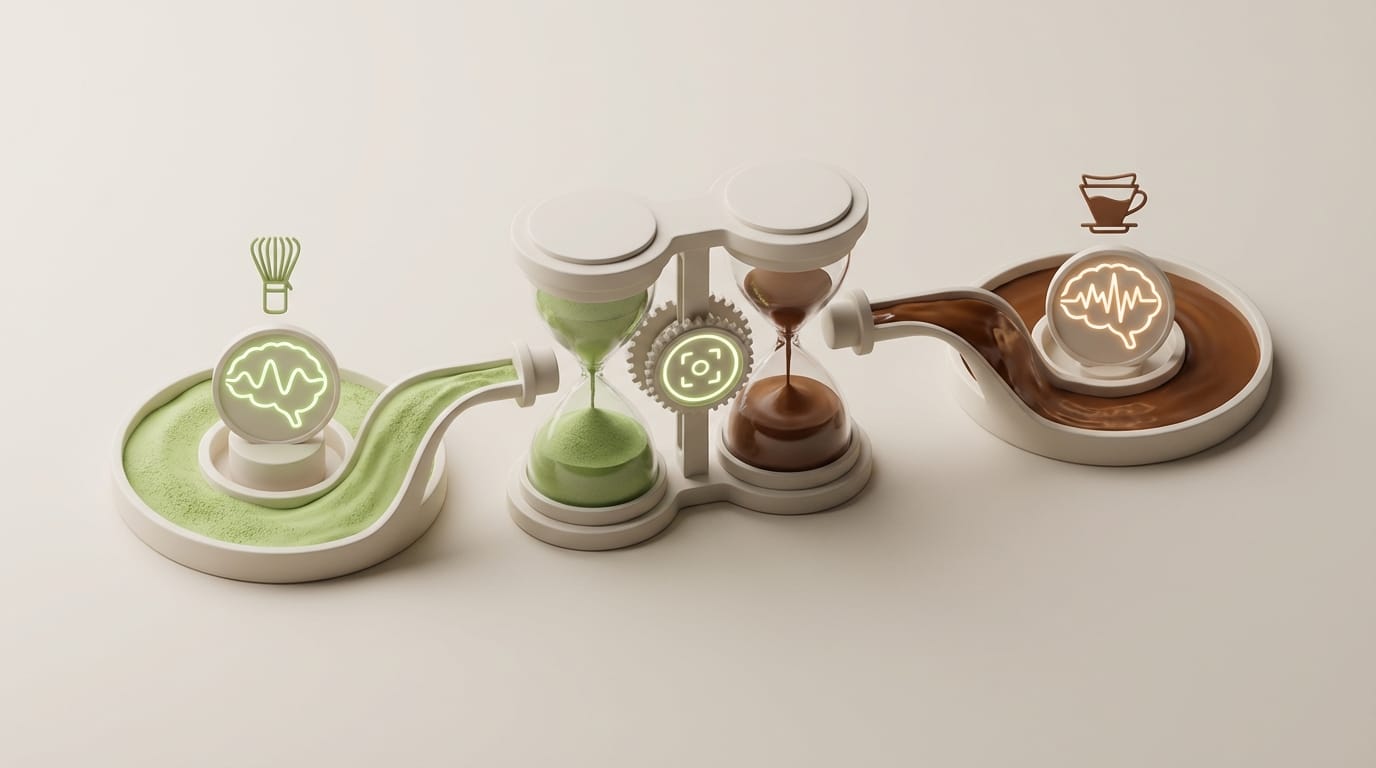
The Molecular Difference in Caffeine Delivery
Most people focus on the dose of caffeine rather than how the brain actually handles the stimulation. We often view caffeine as a single ingredient where 100 milligrams from any source should yield the same results; however, the body tells a different story. Choosing matcha vs coffee for energy changes your focus because it alters how stimulants reach your central nervous system. This shifts your mental state from raw alertness to a more stable, quiet concentration.
To understand why these two drinks feel so different, we must look at the delivery systems. Coffee and matcha are not just ways to get caffeine into the body; they are complex biological packages that interact with your metabolism in unique ways. One acts like a fast shot of energy that demands a later repayment, while the other works like a slow-release tool designed for endurance.
When you optimize your focus, you are managing a chemical system. Misunderstanding how that system responds to different inputs leads to the afternoon fatigue and jitters that many people accept as normal. By breaking down how these drinks work at a cellular level, we can use them as precision tools for wakefulness rather than blunt instruments.
How the body absorbs coffee and matcha
Coffee delivers caffeine in a form that the body can use immediately. Because coffee is a liquid pulled from roasted beans, the caffeine stays “free” and unbound by the time it reaches your cup. This allows the stomach and upper gut to absorb it fast. Research shows that the body absorbs nearly all the caffeine in coffee within minutes, according to clinical data on caffeine uptake, with blood levels peaking as early as 15 minutes after your first sip.
Matcha works differently because it is a suspension. When you drink matcha, you swallow the entire ground tea leaf, which keeps the caffeine tucked inside a “food matrix.” The caffeine binds to larger molecules like fiber and plant nutrients that require time to break down. This physical state forces the body to process the caffeine in the small intestine rather than the stomach, which naturally stretches out the energy timeline.
The role of plant nutrients in slowing energy release
Beyond the leaf particles themselves, matcha contains high levels of tannins and catechins. These plant compounds act as natural brakes on caffeine. They form a temporary bond with the caffeine, slowing the rate at which it passes through the intestinal wall and into the blood. This creates a time-release effect that prevents the sharp spike in energy seen with espresso or drip coffee.
This slower entry is vital for anyone managing their internal energy levels. In the same way that creating a better night’s sleep involves managing chemical triggers, choosing your morning drink involves managing the speed of your “upward” trigger. A rapid spike often sets off a stress response, whereas a gradual rise allows the body to stay calm while increasing mental capacity. This modulation is the core of the matcha vs coffee for energy comparison; you are getting a smoother version of stimulation that prevents the nervous system from panicking.
How L-theanine Creates a State of Alert Calm
The most important part of the matcha experience is L-theanine. This is an amino acid found almost only in shade-grown tea plants. It creates a synergy where two compounds work together to produce a result greater than they would alone. L-theanine can cross the blood-brain barrier to influence your chemistry by helping the brain produce alpha waves.
Alpha waves represent a state known as “alert calm,” which is the mental frequency tied to creative flow and deep focus. While caffeine works by blocking the signals that tell your brain it is tired, L-theanine increases the signals that tell your brain it is relaxed but attentive. You aren’t just getting energy; you are getting a balanced form of wakefulness that keeps you out of a “fight or flight” mode.
Without L-theanine, caffeine is a pure stimulant. It can increase heart rate, raise blood pressure, and cause the racing thoughts many call jitters. When L-theanine is present, it smooths the edges of the caffeine. This creates a state where you feel the wakefulness of the caffeine but lack the physical anxiety of a heavy coffee dose. For tasks that require precision, this balance is better than raw stimulation, which often leads to mistakes caused by rushing.
Understanding the Metabolic Crash Cycle
To understand the crash, we must look at how the brain tracks fatigue. Throughout the day, a molecule called adenosine builds up in your brain to track your need for sleep. Caffeine works by parking in the spots where adenosine usually goes, which stops you from feeling tired. However, the brain keeps making adenosine while those spots are blocked.
Because the liver clears coffee’s caffeine quickly, those spots often become empty all at once. This creates a “dam-breaking” effect where a massive flood of the “tired” chemical hits the brain. This is the biological cause of the 2 PM slump. Studies on caffeine metabolism suggest that the fast clearance of coffee leads to a harder rebound than the slow taper of tea-based drinks.
Coffee also triggers a larger cortisol response than matcha. Because it enters the blood so fast, the body can see the sudden spike as a minor stress event, which tells the adrenal glands to release stress hormones. For many, this leads to a cycle of needing more; they use coffee to fix the crash, which triggers more stress, eventually making the body less sensitive to its own hormones. This is similar to how recovering after a workout requires balance; you cannot simply push a tired system harder without a cost.
Matching Your Beverage to Your Mental Task
Coffee is the “sprint” of the drink world. It is very effective for tasks that require high speed, repetition, or immediate wakefulness. If you need to shake off sleep fog early in the morning or power through basic chores that require more movement than deep thought, coffee’s fast stimulation is a benefit. It provides the initial push needed to start a project when motivation is low.
In modern work, coffee is often the best tool for simple tasks like clearing an inbox or data entry. Its ability to quickly shut down sleep signals makes it a strong tool for short-term alertness, as long as you are ready for the energy drop that follows the spike. Using matcha vs coffee for energy depends entirely on how long you need that energy to last.
Matcha is the tool for long mental sessions. Because the energy release is a flat plateau rather than a peak, it fits deep work that requires three to five hours of focus. When you are writing code, designing a system, or planning a strategy, you want to avoid jitters or a sudden energy drop. The alpha waves from L-theanine also help with creative problem-solving. While coffee can make the mind move too fast to hold onto complex thoughts, matcha keeps the mind steady for lateral thinking. In a world where using digital productivity tools requires high-level oversight, the stability of matcha is very helpful.
Managing Your Daily Energy Without Jitters
One problem with regular coffee use is how fast the body builds a tolerance. Because the brain’s receptors are blocked so hard, the brain tries to compensate by making even more receptors to hear the fatigue signals. This forces coffee drinkers to use more cups to get the same feeling of being awake. This happens much less often with the steady delivery of matcha.
The way L-theanine dampens the stress response means the nervous system does not feel as under attack. This leads to a slower build-up of tolerance. Matcha users often report keeping the same dose for months while still getting the same benefits. Coffee users, however, often find themselves needing a third or fourth cup just to feel “normal.”
If you want to move from coffee to matcha, a “taper and swap” strategy works best. Instead of quitting coffee cold turkey, which can cause a heavy headache, replace your second cup of coffee with a bowl of matcha. This adds L-theanine to your system to help manage stress while still providing enough caffeine to stop withdrawal symptoms.
A smart energy plan used by many today involves waiting 90 minutes after waking to have a small cup of coffee. This allows your natural sleep chemicals to clear out first. After that, switching to matcha for the rest of the day provides a steady glide through the afternoon. This prevents the late-day crash that often ruins evening plans.
Choosing between matcha vs coffee for energy is a decision about the shape of your day. Coffee provides a high peak that is great for starting your morning but requires careful timing to avoid a fall. Matcha offers a stable level of energy that supports the deep focus needed for modern work. By treating these drinks as different delivery systems, you can move away from “borrowed energy” and toward a more sustainable mental state. Ask yourself if your next task needs a 30-minute burst of speed or a four-hour window of creative focus.