
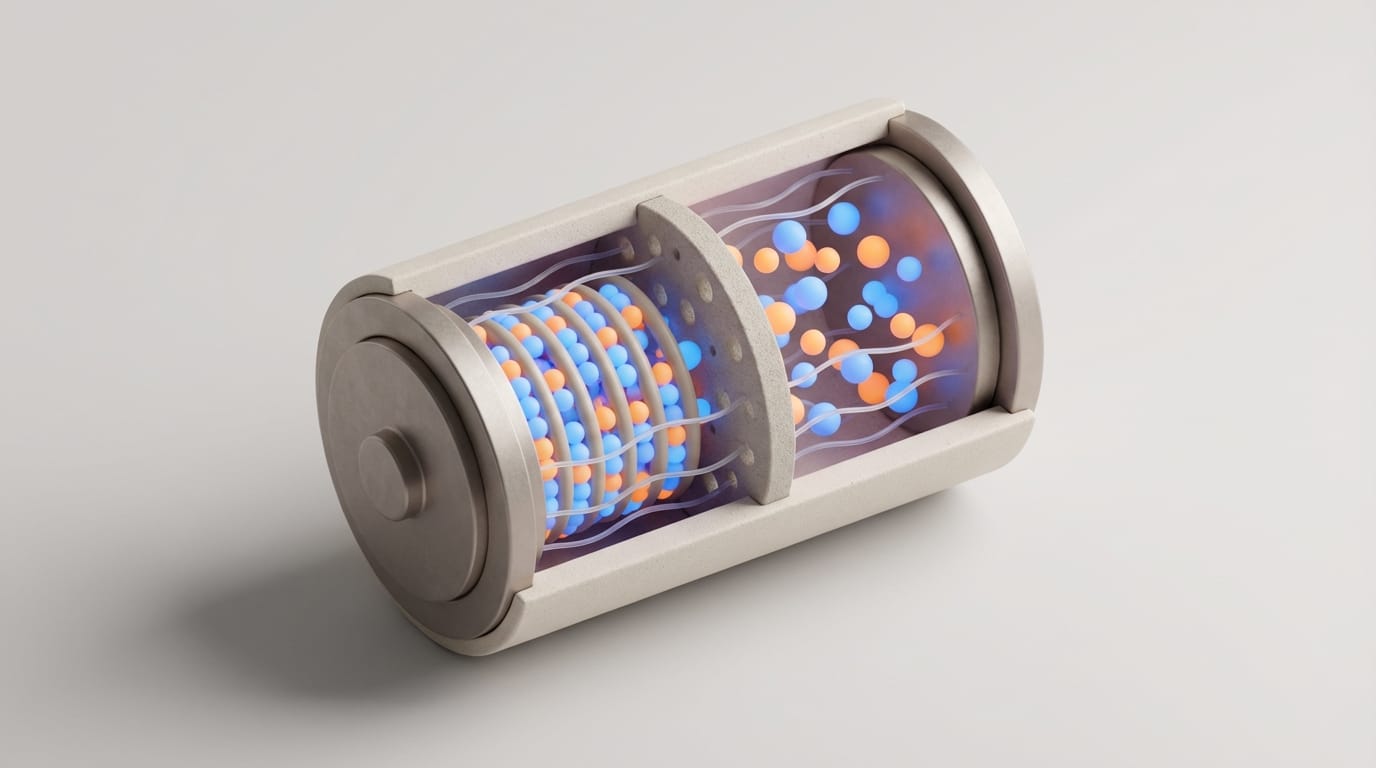
Batteries often look like simple storage tanks, but understanding the volatile chemical balance inside explains why high-performance devices fail or become safety hazards. A battery is a self-contained chemical reactor that manages the movement of charged particles rather than a reservoir of liquid electricity. To understand how batteries store and release energy, we must look past the plastic casing and into the molecular tug-of-war between lithium ions and electrons.
A battery translates chemical potential into electrical work by exploiting the natural tendency of elements to reach a stable state. This process relies on a closed-loop system where ions travel internally while electrons flow through an external circuit to power phones, vehicles, and laptops. When the system maintains this equilibrium, it operates efficiently; when it breaks down, the very chemistry that provides power can lead to structural failure.
As engineers push the limits of energy density to support wearable technology like smart rings, the focus has shifted toward control. It is no longer enough to pack energy into a cell; manufacturers must also regulate the rate and safety of its release. This requires a clear look at the electrochemistry that governs the lifespan of modern power storage systems.
The Fundamental Chemistry of Electrical Potential
The Relationship Between Ions and Electrons
Electrical energy begins as chemical potential because certain materials attract electrons while others release them. In a lithium-ion battery, the system manages this relationship by moving lithium ions and electrons separately. For the cell to remain stable, an electron must move outside the battery every time an ion moves inside it; this keeps the internal and external charges balanced. If this movement stops, the chemical reaction stalls and the battery ceases to provide power.
How the Anode and Cathode Define Power Flow
The anode and the cathode act as the starting and ending points for this journey. During discharge, the anode serves as the negative electrode and holds lithium ions in a high-energy state. The cathode serves as the positive electrode and typically consists of a metal oxide that attracts those ions. The voltage represents the difference in chemical pressure between these two sides. This electrochemical gradient dictates how batteries store and release energy; a steeper gradient gives electrons more force as they move through a device.
The Charging Process and How Batteries Store and Release Energy
Forcing Electrons Against the Natural Gradient
Charging a battery defies natural chemistry. Lithium ions usually stay at the cathode to remain stable, but a wall charger supplies a higher voltage that pushes electrons toward the anode. Because these electrons move to the negative terminal, the positively charged lithium ions follow them through the electrolyte to maintain balance. This process packs the ions into the layers of the anode and creates a state of chemical instability that represents stored energy.
Chemical Transformation During Energy Capture
This storage is a structural transformation rather than just a physical one. In rechargeable cells, the materials allow ions to slide into the molecular lattice of the electrode without destroying its shape. This distinguishes phone batteries from disposable alkaline ones. While primary cells involve one-way reactions that eventually degrade the electrodes, secondary cells use reversible transformations that can occur thousands of times before the material wears out.
How Energy Release Powers External Circuits
The Spontaneous Reaction of Battery Discharge
Turning on a device completes a circuit that lets the battery return to its natural stable state. Lithium ions in the anode move back toward the cathode, but the internal electrolyte acts as a gatekeeper. It allows ions to pass through while acting as an electrical insulator that blocks electrons. To reach the cathode and reunite with the ions, the electrons must travel through the wires of the device; this movement performs work like lighting a screen or running a processor.
Maintaining Charge Balance Through Electrolytes
The electrolyte ensures a steady release of power. If ions cannot move freely, a charge imbalance creates an internal jam that stops the flow of electrons almost instantly. The simultaneous movement of internal ions and external electrons creates a sustainable current, according to the U.S. Department of Energy. This balance keeps the voltage steady until most ions reach the cathode, at which point the device signals that the battery is low.
The Critical Function of the Internal Separator
Preventing Internal Short Circuits
The separator is the unsung hero of energy storage. This thin, microporous membrane prevents the anode and cathode from touching. If they made contact, electrons would bypass the external circuit and flow directly between the electrodes; this causes a massive, uncontrolled release of energy known as a short circuit. Because these membranes are often only 20 micrometers thick, their mechanical strength is vital for device safety.
Managing Ion Flow Efficiency
Modern separators use engineered polymers like polypropylene or polyethylene. Many high-performance cells now use ceramic-coated versions to improve thermal stability under heavy use. These membranes contain tiny pores that let lithium ions pass while maintaining mechanical strength. Research into advanced composite separators shows that tailoring porosity is key to achieving the fast-charging speeds modern electric vehicles require.
Why Thermal Runaway and Safety Hazards Occur
The Chemistry Behind Internal Overheating
High-density batteries risk thermal runaway, a feedback loop where rising temperatures trigger reactions that release more heat. This often starts when the protective film on the anode, known as the Solid Electrolyte Interphase, begins to degrade. If the internal temperature reaches a critical point, the film decomposes and exposes the reactive anode to the electrolyte. This is a primary factor in how batteries store and release energy safely over long periods without venting or catching fire.
How Hardware Protects Chemical Stability
Designers use a multi-layered defense to prevent overheating. Shutdown separators melt and close their pores if temperatures exceed a safe limit, which stops ion flow and effectively turns off the battery. Management systems also monitor voltage to disconnect the cell before damage occurs. Manufacturers frequently release software updates to protect devices and manage charging algorithms to reduce heat during high-speed power delivery.
Factors Influencing Battery Longevity and Efficiency
Degradation of Internal Chemical Interfaces
Every battery cycle causes microscopic mechanical stress. As ions move, the electrode materials expand and contract; this eventually leads to particle cracking that exposes fresh surfaces to the electrolyte. This cracking increases internal resistance and causes the capacity loss we see as devices age. Consequently, extending smart home battery life requires reducing deep discharge cycles to protect the electrode structure from physical fatigue.
Impact of Temperature on Energy Transfer
Ambient temperature affects efficiency significantly. Cold environments make the electrolyte thick and slow down ion movement, which reduces the power the battery can provide. High temperatures accelerate chemical degradation instead. Maintaining an optimal thermal environment is essential to how batteries store and release energy over several years. This balance is vital for modern grid-scale storage systems that must handle the heat generated by large-scale renewable energy sources.
A battery is an active system that responds to its environment and the demands placed upon it. Viewing it as a balance of ion flow, membrane integrity, and thermal management helps us appreciate the engineering behind modern power. As we explore solid-state chemistries or even nuclear fusion power, managing charge and potential remains a cornerstone of technology. Mastering the rules of energy release is the next great challenge for material science as we seek more power in smaller packages.