
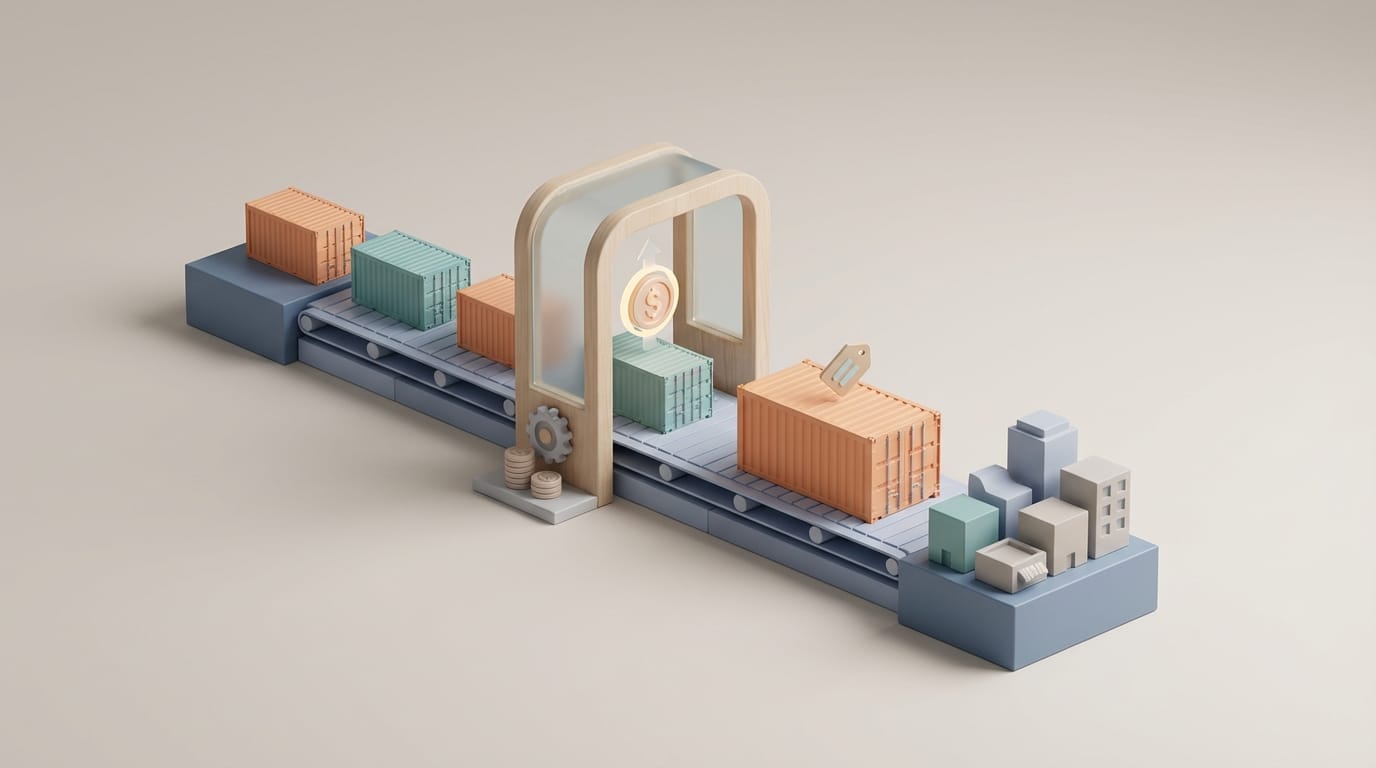
Many view tariffs as a tax on foreign countries, but they function as a domestic cost that forces local businesses and consumers to pay more for everyday products. When a government imposes an import duty, the exporting nation does not write the check; instead, the domestic company bringing the goods into the country pays the fee to its own government. Understanding how tariffs work is essential for recognizing why price tags change at the grocery store or the local car dealership, often long before a single item undergoes a manufacturing change.
This mechanism filters global trade, adding expenses that ripple through how global trade affects consumer costs. For a small business owner or a typical consumer, these policies can feel like an invisible hand pushing costs upward. By exploring the structural logic of these taxes, we can see how a simple policy decision at a port of entry translates into a higher erosion of purchasing power and altered spending habits.
Financial Mechanics: Understanding How Tariffs Work at the Border
To understand how tariffs work in a practical sense, one must look at the “Importer of Record.” This is usually a domestic business (like a retail chain or a manufacturing plant) that is legally responsible for ensuring goods are properly documented and duties are paid. When a shipment of electronics or raw steel arrives at a port, customs agents assess the tax. The domestic business must pay this amount before the goods are released, which immediately ties up their capital and increases their base cost of inventory.
The Direct Role of the Importer of Record
The misconception that the exporting country pays the tariff stems from how political rhetoric frames trade disputes. In reality, the entity seeking the goods bears the financial burden. When a local bike shop imports frames from overseas, they pay the customs duty directly to the treasury, which puts immediate pressure on their cash flow. This often requires them to adjust their budgeting for higher operational costs to account for the sudden spike in expenses.
Specific vs. Ad Valorem Tariff Calculations
Governments calculate these taxes in two primary ways: specific and ad valorem. A specific tariff is a fixed fee per unit; for example, five dollars for every ton of imported cement. An ad valorem tax is a percentage of the item’s total value. If a 10% ad valorem tariff is placed on a $1,000 laptop, the importer pays $100. Research from the World Trade Organization highlights that these taxes drive a wedge between the world price and the domestic price, effectively forcing a higher floor for what those goods can sell for in the local market.
Why Nations Choose to Impose Trade Barriers
Governments do not just use tariffs to raise money; they use them to shield domestic industries. When a foreign competitor can produce a product cheaper (perhaps due to lower labor costs or government subsidies), local manufacturers struggle to compete. By adding a tariff, the government inflates the price of the foreign product, making the domestic version look more attractive to the buyer. This logic often drives the protection of vital industries like steel, semiconductors, or agriculture.
Beyond industry protection, trade policy serves as a tool for national security and diplomatic pressure. A nation might impose tariffs to reduce a trade deficit or to discourage reliance on a specific country for critical components. For instance, the global chip supply network often faces intense trade scrutiny because chips are essential for everything from smartphones to defense systems. By making foreign chips more expensive, a nation hopes to encourage the construction of local foundries, even if the transition period costs consumers more.
The Path from Port Arrival to Consumer Price Tags
Once the importer pays the tariff, they face a choice: absorb the cost or pass it to the customer. If a company has high profit margins, they might keep their prices stable to maintain market share. However, many industries operate on thin margins and have little choice but to raise the retail price. This pass-through effect is why consumers often see prices rise on the shelf just weeks after a new trade policy begins.
For small businesses, the impact is sharp. Unlike massive corporations that can negotiate better terms with suppliers or move production to different countries, small businesses lack the means to offset new costs. They might raise prices significantly, which potentially drives customers toward larger competitors who can better weather the financial storm. This complexity shows that tariffs are not just a line item on a spreadsheet; they are a systemic pressure that reshapes the competitive environment.
How the Price Umbrella Affects Locally Made Products
A common myth is that tariffs only affect imported goods. In reality, they often trigger a phenomenon known as the “price umbrella.” When the price of an imported product rises, it creates a ceiling that domestic manufacturers can move toward. If an imported washing machine goes from $500 to $600 because of a 20% tariff, a domestic manufacturer who was selling a similar machine for $510 might raise their price to $580. They remain the cheaper option while increasing their profit margin without any increase in their own production costs.
Harvard research has shown that during trade disputes, prices for domestic items often rise alongside their imported counterparts. For example, during trade cycles in recent years, retail prices for both imported and domestic goods rose because domestic brands took advantage of reduced competitive pressure. This means that a “Made in USA” label does not necessarily protect a consumer from the effects of trade policy. The consumer ends up paying more across the board, regardless of where the product originated.
Long Term Economic Consequences of Sustained Tariffs
In the long run, tariffs rarely exist in a vacuum. Trading partners almost always respond with retaliatory tariffs. If Country A taxes Country B’s steel, Country B might respond by taxing Country A’s agricultural exports. This can lead to a trade war where exporters on both sides lose access to key markets. According to data from the St. Louis Fed, these cycles can result in a reduction of real income for both nations as trade patterns become less efficient and more expensive to maintain.
Sustained tariffs also lead to permanent shifts in infrastructure. To avoid high duties, companies may move their manufacturing hubs to countries not subject to the penalties. While this might move jobs out of the targeted country, it does not always bring them back to the domestic market. Instead, production often shifts to other low-cost regions, creating a geographic bypass that complicates global logistics without necessarily solving the underlying trade imbalances.
Understanding how tariffs work reveals that they are not just taxes on foreign entities, but a fundamental redesign of the domestic pricing environment. By creating a price umbrella, these policies allow local manufacturers to increase their rates while still appearing competitive against taxed imports. This system essentially forces the domestic consumer to fund industrial protection through higher daily expenses, regardless of where their favorite products are made.
The broader implication is that trade policy is never a localized event; it is a systemic shift that influences everything from small business solvency to global manufacturing footprints. As supply chains continue to evolve, the true cost of protectionism will likely be measured not just in collected duties, but in the reduced purchasing power of the average household. Protecting domestic industries from competition might offer short-term relief, but it often raises long-term questions about innovation and efficiency in a global market.