Understanding the New Face of Digital Fraud
AI is growing up fast. In the past, you could spot a scam easily. You looked for bad grammar or blurry photos. You listened for robotic voices. Those signs are gone now. Your own judgment is the last line of defense. This is a weak spot for many people. To stay safe, you must learn how ai-powered scams work. These tricks use smart software to fool your brain. They use fake media to win your trust. You must understand how this tech bridges the gap between what you see and what is real.
The Way Scammers Use AI Today
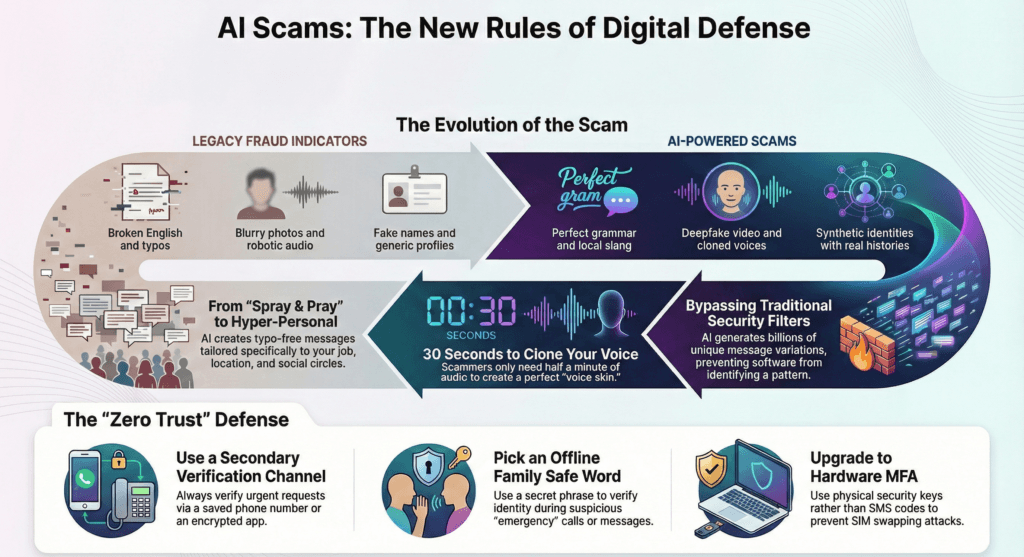
Scams are changing in two ways. They are getting bigger and they are getting better. In the old days, scammers sent millions of generic emails. They hoped a few people would click a bad link. This was called “spray and pray.” It was messy and easy to catch. AI has changed the game. It allows scammers to send perfect messages to many people at once. These messages look like they were written just for you.
How AI Writes Better Lies
Smart computer programs can now write like humans. These are called Large Language Models. They have read almost everything on the internet. They know how people talk in different jobs. They know the slang people use in different towns. This means the “broken English” of old scams is gone. The AI makes no typos. It uses the right tone for your boss or your bank. It removes the language blocks that used to keep you safe.
Scammers also use AI to make fake people. They create “synthetic identities” from scratch. These fake people have profiles on sites like LinkedIn. They have professional headshots and life stories. If you search for them, they look real. They have a history that seems solid. This makes it very hard to know who is real and who is a computer.
The Danger of Fake Voices
Voice cloning is a very scary tool. A scammer only needs thirty seconds of your voice. They can find this on YouTube or social media. They can even record you during a short prank call. The AI then makes a “voice skin.” This skin sounds exactly like you. It copies your pitch and your pace. It even copies the way you breathe or laugh.
The scammer then uses a “Text-to-Speech” tool. They type words, and the tool says them in your voice. They can do this during a live phone call. They can leave voice notes that sound like they came from a friend. This tech used to be hard to find. Now, anyone can buy it online for a few dollars. It is a major part of many ai-powered scams today.
Common Ways AI Scams Target You
The tech is only one part of the problem. Scammers also use “social engineering.” This means they trick your mind. They do not just send links. They build stories that feel true. They use AI to make these stories very personal.
Tricks on Social Media
Scams often start with data scraping. AI bots scan your public posts. They learn where you work. They see who your friends are. They look at your recent trips. The scammer feeds this info into an AI. The AI then writes a message that fits your life.
For example, an AI might see you are at a big work meeting. It can send you a message that looks like it is from the host. It might ask for a “quick favor.” It could ask you to pay a bill or send a file. Because you are at the event, you might not stop to think. The urgency and the facts make the lie feel real.
Fake Deliveries and Invoices
Online shopping is a big target. Scammers use AI to make fake shipping notices. These emails look perfect. They use the right logos and colors. They use real-looking tracking numbers. These emails often sneak past spam filters. This is because the AI changes every email a little bit. Every message has unique words. Security software cannot find a pattern, so it lets the mail through.
In offices, this is called Business Email Compromise. A scammer might pretend to be a seller you know. They use AI to copy the style of your old bills. They send a new bill that looks just like the old ones. The only change is the bank account number. If you do not check, you send money to a thief.
Why Your Computer Cannot Stop Every Scam
Engineers want to solve tech problems with more tech. But AI media is a hard challenge. It is made to look like real data at every level. It does not have the “digital fingerprints” that old viruses had.
The Limits of Security Software
Old security tools use a “blacklist.” They have a list of bad links or files. They block anything on that list. AI content bypasses this system. Every AI output is new. It is a “novel” creation. There is no master list of AI emails. A computer can make a billion versions of the same lie. Each one uses different words. This makes it impossible for software to flag them all as spam.
How Scams Mess With Your Head
The best ai-powered scams use your own feelings against you. When you hear a voice you know, your brain skips the “check for lies” step. You feel a sense of trust. Your brain reacts with emotion rather than logic.
Modern deepfakes are very clean. They do not have the glitches they used to have. You will not see weird shadows or hear static. Scammers also add a sense of hurry. They tell you there is an “emergency.” They want you to act fast. They want to beat your rational mind. If you are scared or rushed, you are more likely to fall for the trick.
How to Use “Zero Trust” to Stay Safe
The only real defense is a “Zero Trust” rule. In the world of computers, this means “never trust, always verify.” You must use this rule in your life too. You must treat every digital message with care. This is the best way to stop ai-powered scams from working.
Use a Second Way to Check
A “Zero Trust” rule needs a “secondary channel.” This is a second way to talk to someone. If you get a message about money or data, stop. Treat it as a fake by default. It does not matter how real it looks or sounds.
Verify the request through a different path. If you get an email, call the person on a saved number. If you get a voice clip, send a text on an encrypted app. Talk to them in person if you can. Most importantly, do not use the phone number inside the message. That number likely goes to the scammer. Use the contact info you already have in your phone.
Pick a Family Safe Word
For families and small teams, use a “safe word.” This is a secret word or phrase. Only you and your circle know it. It should be something weird that an AI cannot guess.
If your boss or child calls with a strange request, ask for the word. An AI will not know it. It is not in the AI training data. This is a low-tech way to beat high-tech scams. You must pick this word in person. Do not write it in an email. Do not save it in a cloud file. Keep it offline so hackers cannot find it.
Practical Tips for Regular Users
Do not rely only on your eyes. But you can still look for small “tells.” Some AI tools still make small mistakes. These can help you spot a fake if you look closely.
Look for Small Errors
- Blinking: Some AI videos do not show natural blinking. The eyes might stay open too long. Or they might blink too fast.
- Lighting: Look at the shadows. AI often fails to match the light on a face with the light in the room.
- Voice Flow: Listen for breathing. AI voices often sound too perfect. They do not use “um” or “uh” naturally. They might not pause for breath at the right times.
- Teeth: AI has a hard time with the inside of the mouth. Teeth might look like a solid white block. They might look blurry when the person speaks.
Better Ways to Lock Your Accounts
You must keep your tools strong. Multi-factor authentication (MFA) is a must. But some MFA is better than others. Do not use text messages for your codes. Scammers can steal your phone number. This is called “SIM swapping.” They can also use AI to trick phone company workers.
Use hardware keys like those from Yubico. Or use apps like Authy. These do not send a code over the air. They use math to prove who you are. This is much harder to hack. It stops scammers from using social tricks to get into your accounts.
Building a Strong Future
The fight between AI makers and scammers will go on for a long time. We cannot just wait for better detection tools. We must change how we think about what is real. We need to know where our data comes from.
Digital Signatures are Coming
In the future, digital content will have a “signature.” This is like a seal on a letter. It proves the person who sent it is real. Websites already use these for security. Soon, people might use them for video and voice calls. Groups like Microsoft and Adobe are working on this now. They want to help you tell the difference between a real video and an AI edit.
Keep Your Mind Sharp
There are many types of bad actors. Safe AI companies like OpenAI and Anthropic put rules on their tools. But some people use “open source” AI. They can remove the rules. This lets them make ai-powered scams without any limits.
Your best tool is a skeptical mind. You do not need to live in fear. You just need to know how the world works today. Your eyes and ears can be tricked by software now. Shift your trust away from what you see. Shift it toward how you verify facts. In a world full of fake content, your real-life connections are the most valuable things you have.