
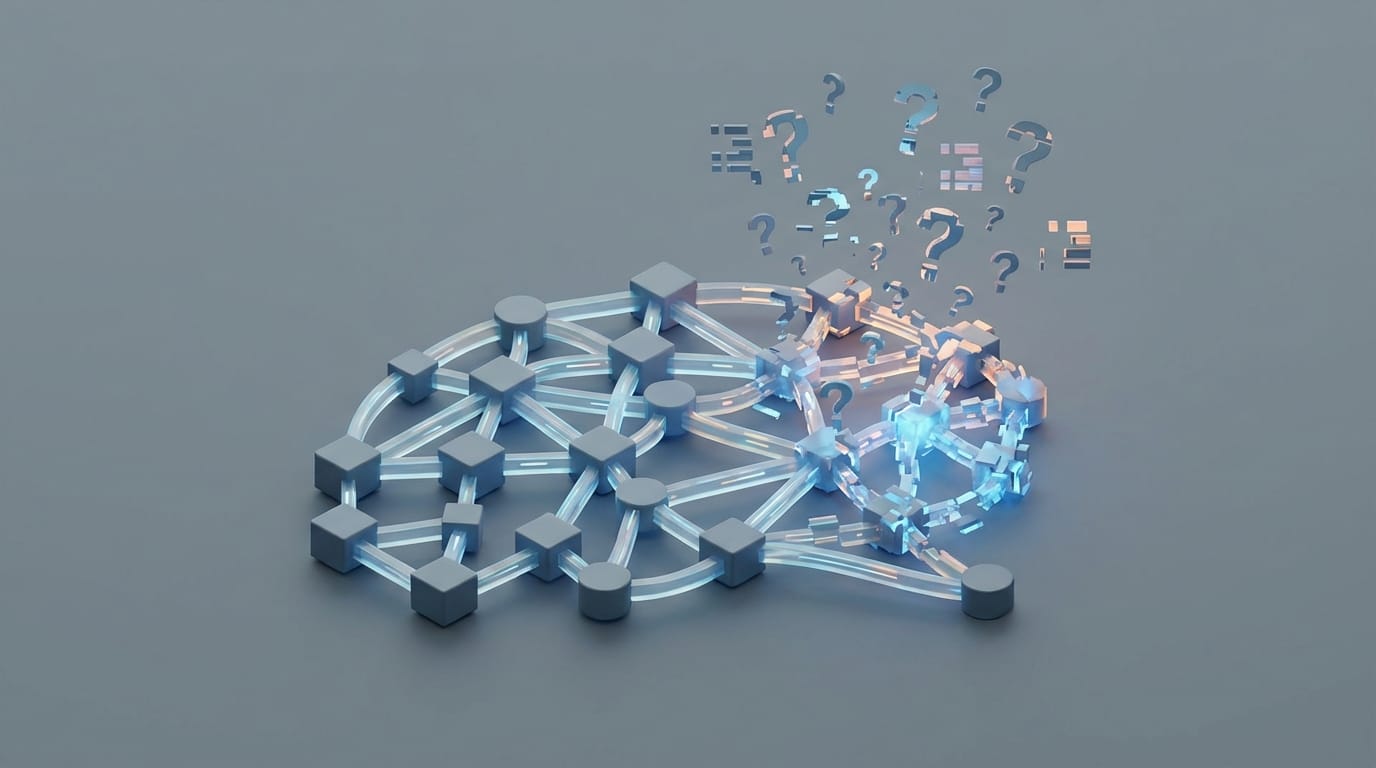
Defining AI Hallucinations in Large Language Models
You might think ai hallucinations are just software bugs. In reality, they are a natural part of how AI creates text. To understand why ai hallucinations happen, you must look at how neural networks work. These models do not follow a simple list of rules. Instead, they use math to process information in complex ways.
In the world of AI, a hallucination happens when the model makes up a fact. The text looks right and sounds confident. However, the information is wrong or makes no sense. These are different from math errors. A math error happens when the model fails to follow a step. A hallucination happens when the model fills in the blanks with fake data. You can think of it like a student who forgot to study for a test. Instead of leaving a blank page, the student writes a very long and pretty story that is completely false.
These fakes can be small or large. A model might say the wrong person said a famous quote. It might also invent a whole legal case or a fake scientific study. The model is not lying to you on purpose. It does not know what truth is. It has no intent. It just runs a math function to pick the next word in a list.
The Math Game: Why AI Hallucinations Are Not Bugs
Many people think ai hallucinations are like a glitch you can patch. This is not true. The system that lets a model write a poem is the same system that leads to fake facts. Both tasks use the same math. The model predicts the next “token.” A token is just a word or a part of a word. It picks this token based on patterns it learned during its training.
Large language models care more about smooth writing than facts. When you ask a question, the model does not look at a database of facts. It calculates the odds of words appearing together. If the model does not know a detail, it does not stop. It does not show an error message. It keeps picking the most likely words. This leads to a story that sounds perfect but is totally fake. Today, on January 12, 2026, we still see these models struggle to admit when they lack data.
The same math that gives the model a creative spark also lets it drift away from the truth. To the model, a fact is just a high-probability string of words. There is always a trade-off. If you want the model to be more creative, you increase the randomness. This makes the writing better, but it also makes the model more likely to make things up.
How Data Problems Cause AI Hallucinations
The data used to train a model sets the limits of what it knows. Companies like OpenAI and Anthropic train their models on the whole internet. This means the models learn all the lies and old facts found online. If the training data is messy, the output will be messy too.
Missing data is a big reason for ai hallucinations. If a model finishes its training in 2024, it knows nothing about the year 2025. When you ask it about recent events, it tries to guess. It uses old patterns to project a fake present. You might get an update about a news event that never happened. The model is simply trying to be helpful by finishing your thought.
Conflicting data also causes trouble. The model might read two different birth dates for the same person. It has no way to check which one is right. It might pick one at random. It might even try to find a middle ground between the two. This creates a story that seems real but is actually false. The model lacks a “truth sensor” to judge its own training data.
The Limits of AI Design and Focus
Most modern models use a design called the Transformer. This design uses “attention” to understand how words in a sentence relate to each other. You can think of attention like a spotlight. It helps the model focus on the most important parts of your prompt. However, this spotlight has limits. In a very long chat, the model can lose its focus. This is called “context drift.”
Overfitting is another design flaw. This happens when a model learns its training data too well. Instead of learning how to think, it just memorizes answers. If your prompt looks like a famous quote, the model might force the answer to match that quote. It will “correct” you even if you wanted something different. It hallucinates a correction because it is stuck on a specific pattern.
There is also a limit to how much a model can “see” at once. We call this the context window. If a document is too long, the model forgets the beginning. It might lose track of who a pronoun refers to. If the model forgets who “he” is, it will just make up a name. It does this to keep the grammar correct, even if the person it names is wrong.
How Your Prompts Change the Results
The way you talk to a model changes how often it makes things up. These models want to be helpful assistants. This often turns them into a “Yes-man.” If you ask a leading question, the model will try to agree with you. If you ask why George Washington used a laptop, the model might make up a reason. It tries to follow your lead instead of telling you that your question is wrong.
Your prompt becomes the most important part of the math. The model assumes your facts are true. It builds its next words on the base you provide. This makes the way you write your prompts very important. You must be careful not to trick the model into a fake answer.
- Agreement: The model accepts your false claims to keep the chat going.
- Too much noise: Long chats make it hard for the model to find the right facts.
- Confused goals: If you give too many rules, the model might break one to follow another. This often leads to fake data.
Ways to Lower the Risk of AI Hallucinations
We cannot stop ai hallucinations yet. However, we can make them happen less often. One top method is Retrieval-Augmented Generation or RAG. This system does not let the model guess. Instead, it uses tools like Pinecone or LangChain to find real documents first. The model then uses those documents to answer your question.
This changes the model’s job. It stops being a creator of facts. It becomes a summarizer of facts. If the answer is not in the documents, you can tell the model to say “I do not know.” This one step cuts down on fake answers a lot. It keeps the model focused on real data instead of its own guesses.
Human feedback also helps. People grade the model on its answers. If the model makes something up, it gets a low grade. Over time, the model learns that “I am not sure” is a better answer than a fake one. This does not fix the math, but it teaches the model to be more careful. It learns to hide its guesses rather than stop making them.
Using AI Safely at Work
In a professional setting, you should not look for a model that never lies. Such a model does not exist. Instead, you should build a system that manages the risk. You must always have a human check the work. In fields like law or medicine, you should never use AI as the final judge. Use it to write a first draft, but check every fact yourself.
You must set clear goals. AI is a great tool for changing or summarizing text. It is not a perfect source of truth. When you use these systems, you should use tools to cross-check facts. You can even run the same prompt through the model twice. If the answers are different, you know the model is likely making things up.
In the end, ai hallucinations show us how these models “think.” They remind us that we are using math engines, not digital books. These models pick words based on odds, not truth. If you understand how they work, you can design better ways to use them. You can build the guards needed to keep your work safe and correct.