
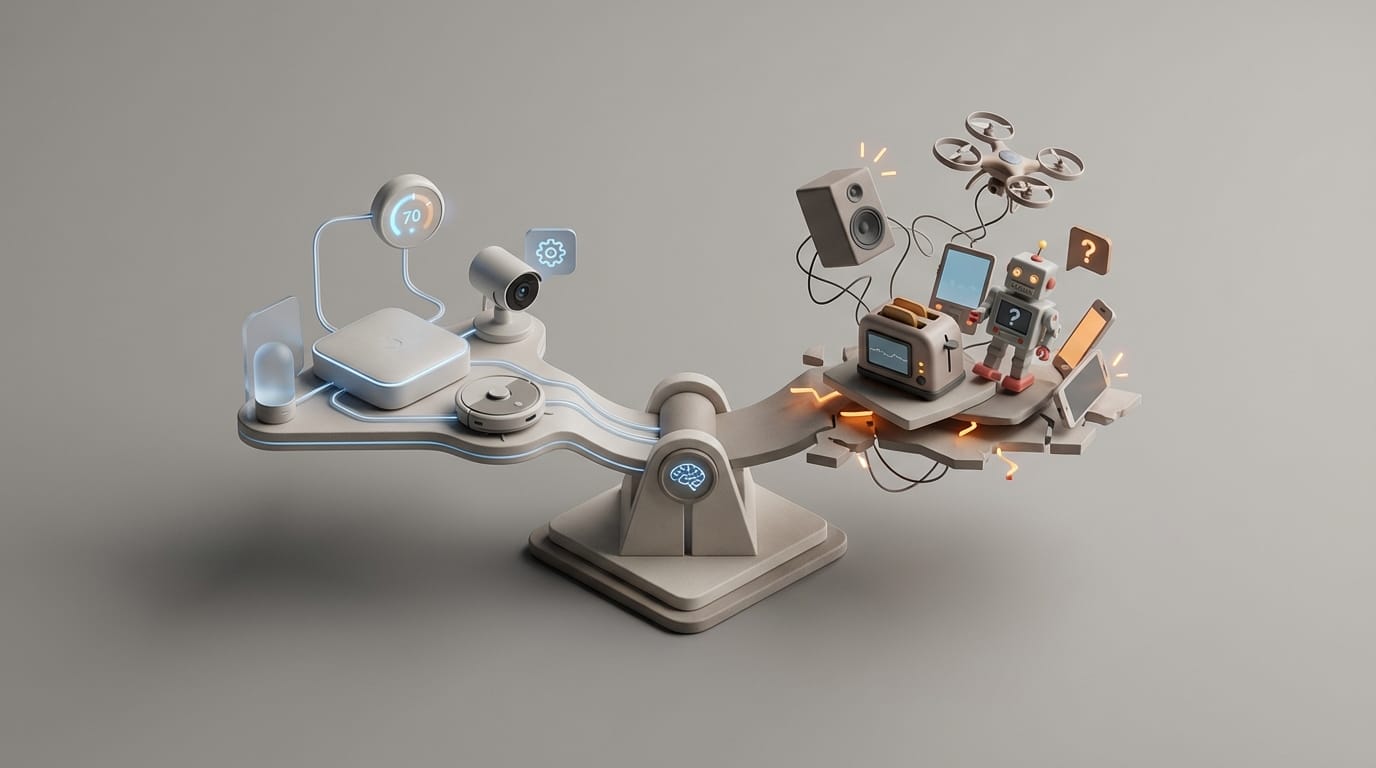
The Current Landscape of Artificial Intelligence in Consumer Tech
Great AI works because you do not notice it. It solves problems by removing steps. When you look at the market, look for practical ai integration. This means tools that make life easier. It does not mean tools that just make art or chat. True value comes from tools that reduce friction. You want tech that helps you work faster without extra steps.
We see a big change in tech right now. For a long time, machine learning worked in the background. It saved your battery life. It sorted your photo gallery. Now, companies use “AI” as a big label to sell things. This label often hides what the software does. You might find it hard to see if a tool is useful or just a toy.
This trend creates two types of tech. One side has tools that make devices faster. These tools feel natural. The other side has “AI-washing.” This is when a company takes a normal update and calls it AI. They might take a simple search filter and give it a new name. This creates a gap. You are promised a smart device. Instead, you get a tool that is hard to use.
Core Characteristics of Practical AI Integration
Good practical ai integration uses invisible utility. You should not have to stop what you are doing to talk to the AI. If you must stop, the system has failed. Its goal is to make you think less. The best systems run in the background. They provide value without you having to ask for it.
Look at how we unlock our phones. Apple made FaceID to solve a problem. It replaced the step of typing a code. It even replaced the step of touching a sensor. You just look at your phone. The AI does the hard work. It maps your face in 3D. It uses infrared light to check your identity. You do not see the math. You just use your device. This is a perfect example of smart tech.
Taking photos works the same way. When you use a Google Pixel, the phone does many things at once. It runs dozens of models in a split second. It fixes the light. It sharpens the edges of a face. It cleans up digital noise. You do not ask the AI to fix the photo. The phone just gives you a better image. This shows that the system wants to solve a problem. It does not want to show off its skills.
Reducing Manual Friction
Tools like predictive text are also very useful. We use them every day and do not think about them. Slack uses machine learning to help you. It puts your most important alerts at the top. It can sum up long chats for you. These features work because we have too much information. You do not need to learn a new way to work. The software makes your current way of working better.
Think about how you sort your email. Good AI learns what is spam and what is not. It does this by watching your choices. If you move a bill to a folder, the AI learns. Next time, it moves the bill for you. You did not have to set up a complex rule. The machine learned your intent. This is how tech should serve you. It takes a boring task and makes it disappear.
The Problem with Conversational Interface Overreach
Many new AI tools try to force you to chat. This is a mistake. Sometimes, a single button click is better than a chatbot. Using a voice assistant can be a step backward. It takes a sure action and turns it into a talk. This can make your tasks take longer.
Talking to a machine for simple tasks is slow. If you want to dim your lights, use a switch. A physical or digital switch takes less than a second. A voice assistant needs a wake word. Then it needs a command. Then you wait for it to think. Sometimes it says, “I did not get that.” Now you are talking to a lamp for ten seconds. This makes the “smart” home feel slow. It adds steps instead of removing them.
Voice tools often fail because human speech is messy. Designers think “talking” means “easy.” For most daily tasks, you want direct control. A button is a promise. You press it and the light turns on. A chatbot is a guess. It might do what you want, or it might not. This lack of certainty is a problem for users who want to get things done.
Identifying Gimmicks in the Smart Home and Wearable Market
The smart home market has many tools you do not need. We see many appliances that use too much tech. Refrigerators now “look” at your milk. Washing machines “learn” your clothes. These features often need more work than the manual task. You have to update the app. You have to check the sensor. The machine is now more complex than a standard one.
Many of these gadgets have the “app-for-a-lightbulb” flaw. A basic bulb works for years. A smart bulb needs a cloud connection. It needs a software update. If your Wi-Fi breaks, your light might not work. This adds a point of failure. These devices also take your data. They track when you are home. They track what you eat. The small benefit is often not worth the loss of privacy.
Longevity is also a worry. AI hardware needs servers to stay alive. If the company closes the servers, your device dies. It becomes electronic waste. A traditional stove can last thirty years. A smart stove might last five. This is a bad deal for the planet. It is also a bad deal for your wallet. You should ask if the AI makes the tool better for a long time.
The Hidden Costs of Pointless AI Integration
Extra AI features have technical costs. Running models in the background uses a lot of power. On a phone, this drains your battery. It also makes the phone hot. This heat can damage the hardware over time. Your phone might not last as many years as it should. You pay for a smart chip, but you lose battery life.
- Battery Drain: Smart features check your status all the time. This eats power faster than normal apps.
- Too Many Alerts: AI tries to predict what you want. It often sends too many notifications. This makes you feel tired of your tech.
- Higher Prices: Companies charge more for AI chips. Many users do not need these chips for their daily work.
Users also get “feature blindness.” This happens when a system gives too many tips. If the AI is wrong a few times, you stop looking at it. You ignore the “smart” pop-ups. This means the engineers wasted their time. They built a tool that you now find annoying. It clutters the screen and slows you down.
Design Frameworks for Meaningful AI Implementation
To reach true practical ai integration, designers must focus on your intent. They should look for things that frustrate you. They should not just look for a way to use a new model from OpenAI. Good design starts with a human problem. It does not start with a piece of code.
A good system keeps you in charge. AI should act like an assistant. It should offer “drafts” or “ideas.” You can then accept them or throw them away. It should not take big actions on its own. If it makes a mistake, it should be easy to fix. This is vital for safety tools. You must always know what the machine is doing.
Great tools also use quiet loops. If an AI suggests a folder and you say no, it should learn. It should not ask you to fill out a survey. It should just watch and get better. This lets the tool grow as you use it. You do not have to spend an hour in the settings menu. The software adapts to your life, not the other way around.
Future Directions for Seamless Consumer AI
The next step for practical ai integration is on-device processing. Companies like Qualcomm build new chips. These are called Neural Processing Units. They let the AI run on your phone instead of the cloud. This makes the AI faster. It also keeps your data safe. Your private info never leaves your pocket.
We are moving toward “ambient intelligence.” This is a world where your home knows what you need. It does not wait for a command. If you are cold, the heat turns up. It knows this because it sees the weather. It knows your habits. It does not ask you a question. It just creates a comfortable space. This is the goal of smart tech.
AI will soon move away from big tricks. It will move toward specific automation. We do not need a phone to write a poem. We need a phone to book a doctor’s visit. We need it to handle the boring parts of life. The “smartest” device is the one you think about the least. It works so well that it feels like it is not there at all.
“The most profound technologies are those that disappear. They weave themselves into the fabric of everyday life until they are indistinguishable from it.”
The tech world must focus on being invisible. Tools must be reliable. They must respect your time. If the industry does this, we can move past the hype. We will find a future where tech offers real help every day.