
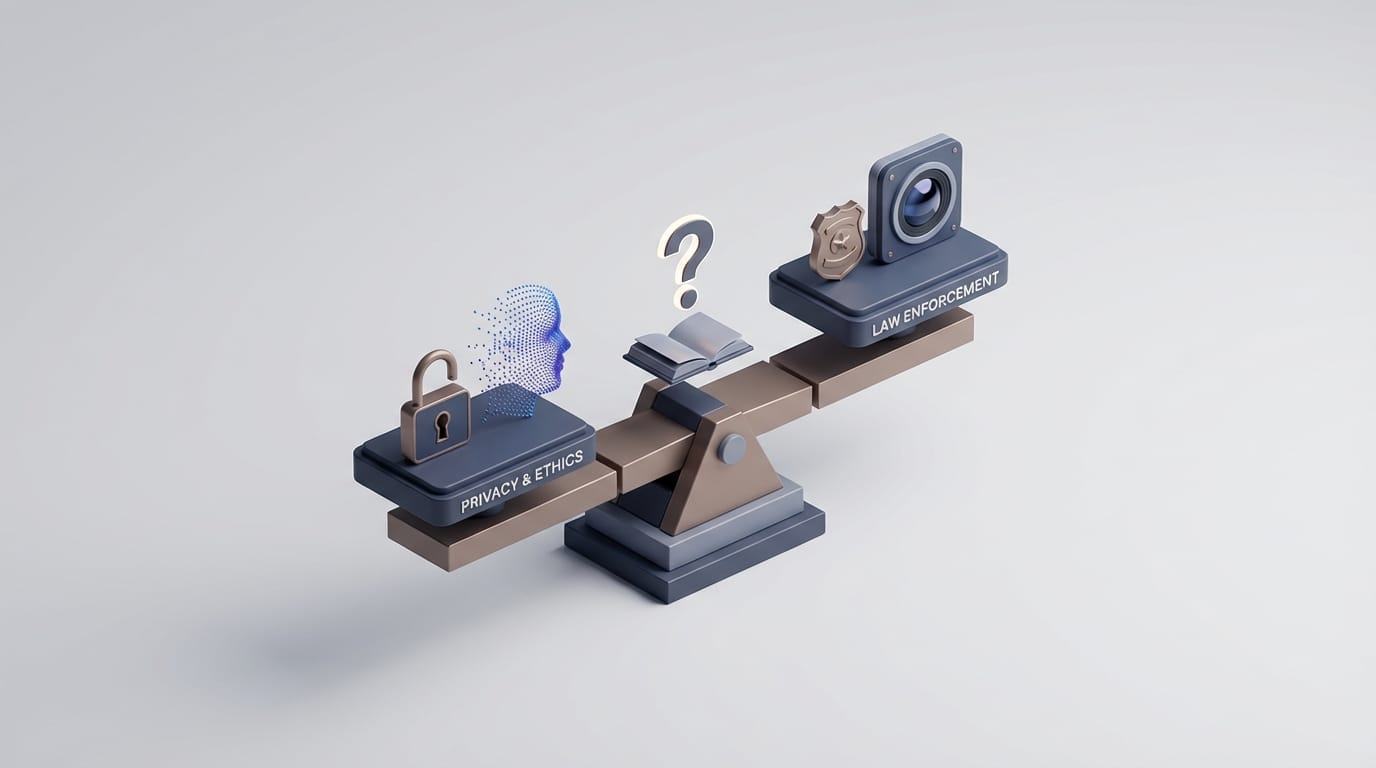
The integration of facial recognition into modern policing marks a fundamental shift from human observation to automated surveillance. This transition challenges the historical expectation of anonymity in public spaces, replacing temporary encounters with permanent records. To evaluate this change, we must examine facial recognition technology law enforcement ethics through the lens of technical precision, civil liberties, and the erosion of practical obscurity.
When these systems are deployed, they do more than speed up identity checks. They re-engineer how the state interacts with individuals in public. This shift replaces the biological limits of human memory with the near-infinite recall of centralized databases. Understanding this change requires a rigorous look at the underlying machinery and its societal consequences.
Technical Foundations of Facial Biometrics in Policing
Facial recognition is the mathematical translation of human geometry. A system captures an image and identifies specific “nodal points,” such as the distance between the eyes, the width of the nose, and the depth of eye sockets. These points are converted into a feature vector—a numerical representation that serves as a digital signature for a specific face.
In law enforcement, these vectors are used in two distinct ways:
- 1:1 Verification: The system compares a live capture against a specific reference image, such as a passport photo, to confirm an identity. This is common at border crossings and secure facility entrances.
- 1:N Identification: The system compares an unknown face against an entire database of millions to find a match. This transforms every individual in a crowd into a potential search query.
These systems rely on large-scale databases for both training and deployment. While some agencies use internal booking photos, others use third-party providers like Clearview AI, which scrapes billions of images from social media and public websites. This creates a loop where private data, shared without the intent of police use, becomes the foundation of surveillance infrastructure.
Biometric Data Capture and Feature Vector Mapping
The accuracy of feature vector mapping depends on the quality of input data. Variables such as lighting, angle, and camera resolution introduce “noise” into the mathematical model. When an algorithm maps a face, it produces a similarity score rather than a definitive “yes” or “no” answer. Ethics in this space often hinge on where a department sets its threshold for a match and whether a human analyst provides a meaningful check on the machine’s output. If the threshold is too low, the system produces too many false leads; if it is too high, it may miss legitimate targets.
Integration with Law Enforcement Databases and Third-Party Systems
The power of these tools is amplified by their integration with other data streams. When facial recognition is linked to real-time CCTV networks or Body-Worn Camera (BWC) systems from providers like Axon, it enables persistent tracking. This integration shifts the technology from a forensic tool used after a crime to a proactive monitoring system. An individual can be identified and tracked in real-time as they move through a city, effectively removing the logistical barriers to 24/7 surveillance.
The Erosion of Practical Obscurity in the Digital Age
Historically, being in public was not the same as being identifiable. This is the concept of “practical obscurity”—the idea that while your face is visible, the effort required to identify, follow, and record your movements was too high for any entity to do at scale. Anonymity was the default state of public life due to the physical limitations of human surveillance.
Widespread deployment removes this friction. In an environment where facial recognition technology law enforcement ethics are not strictly defined, a person walking to a medical clinic or a political meeting is no longer just a face in the crowd. They are a data point that can be instantly cross-referenced with social media profiles, employment history, and criminal records. This automation eliminates the natural privacy protections that distance and human fallibility once provided.
This shift fundamentally changes the public square. When identification becomes instantaneous, the assumption that your presence in a public park is a fleeting, unrecorded event is replaced by the reality of a permanent, searchable digital trail. This creates a world where our past movements can be reconstructed by any agency with access to the database.
Transition from Targeted Surveillance to Persistent Identification
In traditional policing, surveillance requires “reasonable suspicion.” An officer follows a specific person based on evidence. Facial recognition changes this hierarchy by subjecting everyone within a camera’s field of view to a search, regardless of suspicion. This “general search” capability moves law enforcement away from targeted investigation toward a model of persistent identification that was previously impossible to maintain. It treats the public space as a crime scene in perpetuity, where every bystander is a subject of interest until the algorithm says otherwise.
Facial Recognition Technology Law Enforcement Ethics and Algorithmic Bias
One significant technical challenge is the prevalence of demographic disparities in recognition rates. Multiple studies, including those by the National Institute of Standards and Technology (NIST), have demonstrated that many algorithms exhibit higher error rates for people of color, women, and the very young or elderly. These disparities often stem from training data that over-represents certain demographics while under-representing others.
The risk of these flaws is compounded by “automation bias,” the human tendency to trust computer output over personal observation. When an officer is presented with a match by a sophisticated platform, they may be less likely to scrutinize the result. This can lead to wrongful arrests and detentions. Several documented cases already exist where misidentification by an algorithm led to the arrest of innocent individuals, highlighting the danger of treating similarity scores as absolute truths.
The Human Element: Verification and Confirmation Bias
The ethics of the system are only as strong as the human oversight involved. If the software is used as a lead generator, it requires a “double-blind” human review process to mitigate confirmation bias. Without strict protocols, the algorithm’s flaws are inherited by the justice system. This leads to disparate impacts on marginalized communities who are often more likely to be over-policed. A robust system requires that an officer arrive at an identification independently of the software’s suggestion to ensure the machine is a tool, not a witness.
Civil Liberties and the Chilling Effect on Public Life
The pervasive use of facial recognition has implications for the First Amendment right to free assembly. If individuals believe that attending a protest or a religious gathering will result in their identity being logged into a police database, they may choose not to participate. This “chilling effect” suppresses civic engagement and shifts the power balance between the citizen and the state. The right to gather anonymously is a cornerstone of democratic expression that is difficult to maintain under constant biometric observation.
Under the Fourth Amendment, the legal debate centers on whether individuals have a “reasonable expectation of privacy” in their public movements. While the Supreme Court has historically held that what a person knowingly exposes to the public is not subject to Fourth Amendment protection, the advent of automated tracking challenges this. The scale and duration of digital surveillance may soon be viewed as a search that requires a warrant, as the data collected is far more revealing than any single visual observation by a passing officer.
The Psychological Impact of Perpetual Digital Observation
Beyond legalities, there is a psychological cost to losing anonymity. Living under the constant gaze of an identifying system changes how people behave. It creates a “panopticon” effect, where the uncertainty of being watched leads to self-censorship and a breakdown of community trust. When people know they are being identified, they are less likely to engage in the eccentric, the experimental, or the dissenting behaviors that characterize a free society. For policy makers, the question is whether marginal gains in investigative efficiency are worth this systemic erosion of public freedom.
Current Regulatory Frameworks
The response to facial recognition is currently a patchwork of local and international laws. As of January 8, 2026, several cities have implemented outright bans on the use of the technology by local police, arguing that the risks to civil liberties outweigh the benefits to public safety. These bans reflect a growing skepticism toward the “inevitability” of total surveillance.
In contrast, other jurisdictions have opted for use-case restrictions. These frameworks allow the technology for serious crimes, like kidnapping or terrorism, but prohibit its use for low-level offenses or general surveillance. Internationally, the Artificial Intelligence Act in the European Union categorizes real-time biometric identification in public spaces as “high-risk,” requiring strict oversight and transparency measures that far exceed current American standards.
The Necessity for Audit Trails and Data Retention Limits
A robust regulatory framework requires more than rules on when to use the software. It must include mandatory audit trails that document every search, the justification for it, and the identity of the officer involved. Furthermore, data retention limits are essential. Biometric data of innocent bystanders should not be stored indefinitely in “suspicionless” databases. Without these limits, the system becomes a repository for the movements of the entire population, regardless of criminal involvement.
Establishing Ethical Guardrails for Future Implementation
As we look toward the future, the conversation around facial recognition technology law enforcement ethics must move from reactive debate to proactive design. If these systems are to be used, they must be subject to independent, third-party auditing to verify accuracy and check for bias. Transparency is not an optional feature; it is a requirement for democratic legitimacy. Public trust cannot be maintained if the tools of state power remain proprietary or secret.
Citizens must have a clear pathway to challenge the collection of their biometric data and seek redress when errors occur. This includes “discovery rights” for defendants, ensuring they know if facial recognition was used in their identification during a criminal proceeding. Without this, the technology remains a “black box” that can circumvent the constitutional right to a fair trial by obscuring how an investigation originally began.
“The goal of any biometric system should not be total visibility, but the balanced application of technology that respects the fundamental human right to remain unknown in a crowd.”
Ultimately, the challenge is to balance the forensic benefits of modern tools against the long-term cost of losing public anonymity. We must decide if we are willing to trade the “practical obscurity” that has defined human interaction for centuries for a system of total, searchable visibility. This decision will define the relationship between the state and the individual for generations to come.
To learn more about the legal challenges and advocacy surrounding these issues, organizations like the ACLU and the Electronic Frontier Foundation provide resources on the intersection of technology and civil rights. The systems we build today are the ones we will live inside tomorrow. It is our responsibility to ensure their foundations are both precise and just.